

A cancer diagnosis can make every appointment feel like a pop quiz in a language you never asked to learn. When medical professionals discuss the differences regarding progression-free survival vs overall survival, fear often walks into the room before understanding does. Learning to distinguish between these metrics is a vital part of evaluating treatment efficacy as you navigate your care plan.
The short version is this: progression-free survival tracks how long a treatment keeps cancer from growing or spreading, while overall survival tracks how long patients live after diagnosis. While these terms are frequently used in clinical trials to measure success, the difference matters, especially if you are weighing your treatment options or trying to make sense of the results from your latest scan. Understanding the nuances of overall survival and progression-free survival can help you have more informed conversations with your care team about what your numbers truly mean.
Key Takeaways
- The Two-Stopwatch Concept: Progression-free survival (PFS) measures how long a treatment keeps cancer from growing or spreading, whereas overall survival (OS) tracks the total length of time a patient lives after diagnosis.
- Different Goals: PFS is often used as a faster indicator of treatment efficacy in clinical trials, while OS is considered the gold standard for measuring the definitive, long-term impact on a patient’s lifespan.
- Correlation Isn’t Guaranteed: A treatment may successfully slow cancer growth (improved PFS) without necessarily extending life (OS), often due to the availability of subsequent therapies or differences in how cancer behaves post-progression.
- Individual vs. Group Data: These metrics represent group averages from research studies; they are tools for comparison, not a prediction of your personal outcome or a measure of your individual quality of life.
Two stopwatches, two different answers
Think of two stopwatches on the same table.
The first stopwatch measures how long a treatment keeps the cancer from growing, spreading, or showing clear signs that it has gotten worse. In oncology research, progression-free survival is often used as a primary clinical endpoint because it provides faster results. The second stopwatch measures how long people live after treatment starts or after they join a study. That is overall survival, which is widely considered the gold standard for measuring long-term success in clinical trials.
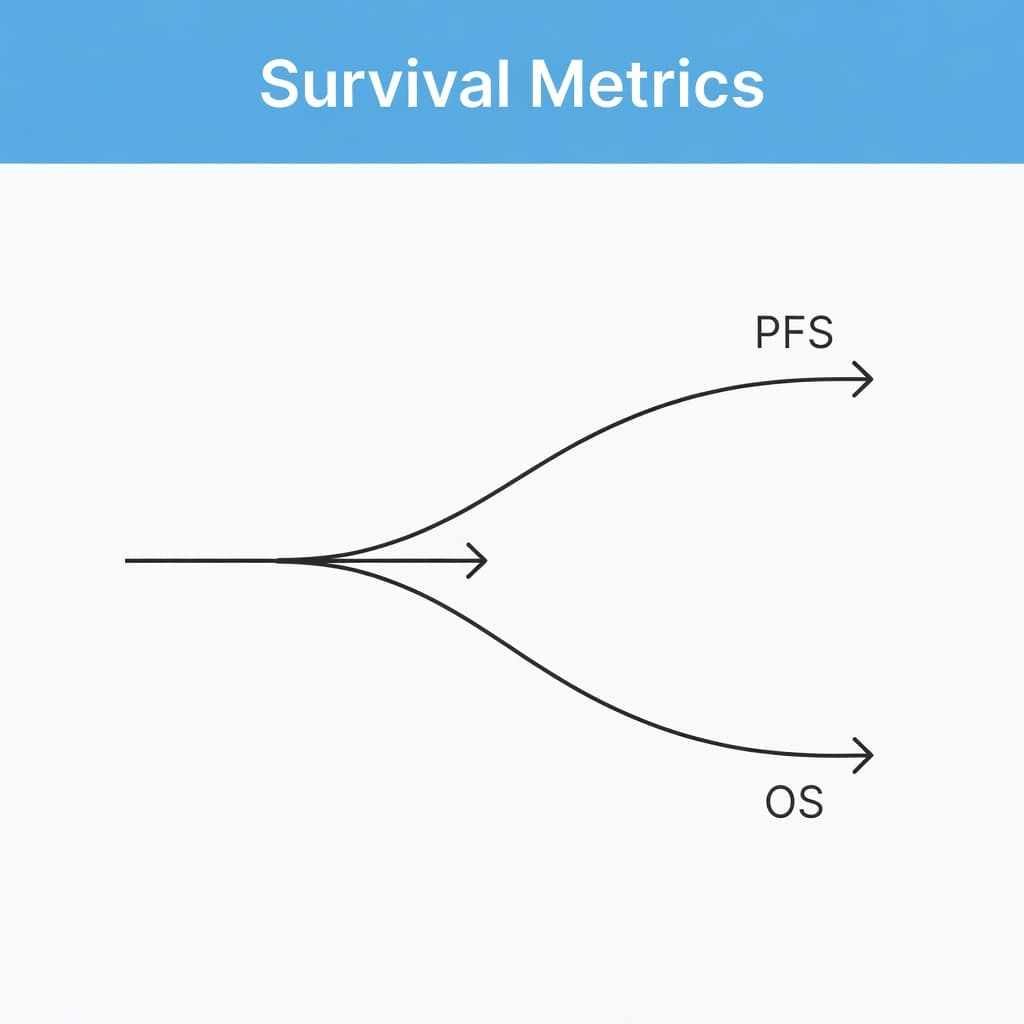
That is the heart of progression-free survival vs overall survival in plain English. One asks, “How long did the treatment hold the line?” The other asks, “How long did people live?”
Here is the difference at a glance.
| Measure | Stopwatch stops when | What it tells you |
|---|---|---|
| Progression-free survival | Cancer grows, spreads, or the person dies | How long the disease stayed controlled |
| Overall survival | The person dies, from any cause | How long people lived |
Researchers rely on standard tools like RECIST criteria to define when a tumor has grown or spread on a scan, which allows them to calculate progression-free survival more efficiently than other metrics. Because doctors do not have to wait as long for these results, progression-free survival often appears in early study reports. By comparison, overall survival takes longer to determine, but it remains the most direct outcome because it addresses the blunt question of patient longevity.
Progression-free survival tells you how long a treatment kept cancer from moving forward. Overall survival tells you how long people lived.
A plain-language NIH primer on cancer study endpoints gives the same basic framework for evaluating clinical trials. Still, numbers on paper and life in your body are not the same thing. A scan result is personal, while a trial result is a group average.
That difference matters. It keeps you from turning one study number into a prediction about your own future.
Why progression-free survival and overall survival can disagree
This is where people often feel confused. If a treatment improves progression-free survival, should it not also improve overall survival?
Sometimes yes. Sometimes no.
In clinical trials, researchers often use progression-free survival as one of the common surrogate endpoints. These surrogate endpoints act as a proxy for the actual goal of extending life, helping doctors estimate how a treatment might work before the final overall survival data is available. While this is helpful, relying on surrogate endpoints requires caution because the correlation between the two metrics is not always perfect.
A drug may hold the cancer steady for longer, and that can matter a great deal. More stable time can mean fewer symptoms, more strength for family life, or more months in which treatment works. For someone living with a life-threatening disease, that is not a small thing.
However, progression-free survival and overall survival do not always rise together. A study may show that cancer stayed controlled longer, yet overall survival barely changed. This can happen due to crossover treatments, where patients in the study move on to receive other powerful therapies after the initial trial drug stops working. Additionally, factors like post-progression survival can mask the true impact of a drug on the final outcome. With the rise of targeted therapies and immunotherapy, the way cancer behaves has changed, sometimes providing a distinct clinical benefit even if the overall survival is not immediately impacted.
Researchers have looked closely at this problem. A research review on how PFS and OS relate found that the connection varies by cancer type and treatment. That means you should resist a common trap: assuming a better progression-free survival number automatically means people lived much longer overall.
The opposite can also happen. A treatment might not produce a dramatic improvement in progression-free survival, yet some people still achieve a clinical benefit and live longer overall because of what comes next or how the disease behaves.
This is why doctors keep both measures on the table. One tells you how the cancer behaved during treatment, while the other provides the definitive answer on overall survival. Neither number tells the whole story alone.
There is one more layer to consider. A treatment can extend the time before the cancer grows but leave someone exhausted or unable to function. When you hear a new result, ask a quiet but brave question: “How did people feel while they gained those extra months?” While overall survival is a primary goal, your quality of life during that time is just as important.
Where these numbers show up in Cancer care
You will see these terms most often in oncology clinical trials, treatment news, and during your doctor visits. If you are reading about a new drug and the headline sounds hopeful, look for which stopwatch the researchers used.
Did the treatment improve progression-free survival? That means the cancer stayed under control longer. Did it improve overall survival? That means people lived longer. These are not identical claims, and for patients with metastatic cancer, understanding the difference is essential. In the context of regulatory approval for new medications, the choice between using progression-free survival or overall survival as a primary endpoint can dictate how quickly a drug reaches the market.
This is one reason explaining clinical trials for cancer patients can make such a difference. Oncology clinical trials use these outcome measures to answer focused questions, and these survival numbers are a vital part of that process. When you understand the specific endpoint, the headline loses some of its power to scare or mislead.
You may also hear these terms when a doctor compares treatment options for solid tumors. One option may have stronger progression-free survival data. Another may have clearer overall survival data. A third may have less survival data but fewer side effects. No single number decides the best path for every person.
A patient-friendly guide to OS and PFS makes a good point: these measures help researchers compare treatments, but they do not measure every part of living with cancer. Fatigue, pain, function, sleep, and hope still count, even when a chart does not show them.
That is also true outside of cancer care. The same idea can appear in studies of heart disease or other chronic conditions because doctors need standard ways to compare outcomes over time. But when the chart belongs to your treatment, the numbers stop feeling abstract.
If you are looking for steady, plain-language support after those heavy appointments, compassionatevoices.org offers education for people facing cancer and other life-threatening diseases.
Questions that help you make sense of the numbers
When survival terms hit you in the middle of stress, you don’t need to sound clever. You need useful questions.
Start with the most basic one: “What does this number mean for someone in my situation?” Not for the average person in a study. Not for a headline. For you.
Here are a few questions worth bringing to your next appointment:
- Does this result show longer progression-free survival, longer overall survival, or both?
- How was progression measured in this study; via scans, symptoms, or both?
- When comparing first-line therapy options, how do these outcomes change?
- What was the median result, and what does median mean here?
- How did people feel on this treatment, and what was their quality of life?
- What treatments came after the study drug stopped working?
That word median matters. If a report says median progression-free survival was 10 months, it does not mean everyone got 10 months. It means half the people had less than that, and half had more. The same goes for median overall survival. You may also see other metrics in your reports, such as disease-free survival or objective response rate. While these numbers provide a clinical benefit when analyzed by doctors, remember that they describe a group. They do not write your personal story.
Sometimes the next right step is another set of ears. If the explanation feels muddy, or the plan feels rushed, getting a fast second opinion for cancer care can help you sort facts from panic.
Symptom support matters too. A treatment can help on paper and still wear you down in real life. If pain, fatigue, anxiety, or sleep trouble keep piling up, understanding palliative support during cancer treatment can open a door many people wish they had opened sooner.
And if you are in remission, these terms can still echo in your mind. That is normal. Once you have lived through cancer, words like progression do not stay on the page. They enter the body. They stir memory. They wake up fear. Clear information does not erase that fear, but it can keep fear from taking over the whole room.
Frequently Asked Questions
If a new drug has a better progression-free survival rate, does it mean it is better for me?
Not necessarily. While a better PFS score means the drug is effective at keeping the cancer stable for longer, you must also consider side effects, your daily quality of life, and whether that specific treatment aligns with your long-term health goals.
Why do researchers use progression-free survival if overall survival is the gold standard?
PFS is often used because it provides results much faster than waiting for overall survival data, which can take many years to collect. By using PFS, researchers can identify promising treatments sooner, allowing patients access to new therapies more quickly.
Does a higher overall survival number mean the treatment cured the cancer?
No, overall survival simply tracks the time from a specific point until death from any cause; it does not explicitly mean the cancer was eliminated. It is a statistical measurement of longevity, which can be influenced by many different treatments a person receives throughout their journey.
Can I ask my doctor to explain these numbers in relation to my specific health scan?
Absolutely, and you should. It is helpful to ask your care team what the trial data means for someone in your specific stage and situation, rather than viewing the raw clinical trial numbers as a definitive prediction of your future.
What to hold onto
When you navigate the complexities of progression-free survival vs overall survival, keep picturing those two stopwatches. One measures how long cancer stays controlled, while the other measures how long patients live.
Both numbers are important, but neither metric defines your entire journey. Instead of simply asking which number sounds better, the most effective question is, “What does this result mean for my time, my body, and my choices right now?” Whether you are looking at data for overall survival or progression-free survival, the ultimate goal remains achieving a clinical benefit that truly aligns with your personal goals and your quality of life.
That is where understanding begins, and where some of the fear starts to loosen its grip.