

When a doctor mentions that you may need a port vs PICC vs Hickman line, it can feel like one more heavy burden to carry. The names sound technical, and the choice can feel much more overwhelming than it needs to be.
The simple truth is that these tools are all types of central venous access devices. Regardless of the specific design, these vascular access devices provide your medical team with a safe way to reach a large vein for treatments, regular blood draws, or both. Once you understand how each option integrates into your daily life, the decision becomes much less mysterious.
Key Takeaways
- Primary Difference: The main distinction is between an implanted port, which sits entirely under the skin, and PICC or Hickman lines, which have external tubing outside the body.
- Treatment Duration and Frequency: Ports are often ideal for long-term treatment with breaks, while PICC and Hickman lines are better suited for intensive, frequent, or daily access needs.
- Lifestyle Considerations: Choosing a device involves balancing clinical needs with personal comfort, including daily care requirements like dressing changes, flushing routines, and activity limitations.
- Placement and Maintenance: Each option has different requirements for insertion, such as minor surgery for ports versus more straightforward insertion for PICC lines, and all require vigilance to prevent infection.
Why people get these lines at all
Chemotherapy and systemic anticancer therapy can be rough on small veins, as many of these medicines are known to irritate delicate vessel walls. Some people also require frequent blood work, fluids, transfusions, or IV medicine over many weeks or months.
That is where these lines come in. Think of them as steady doorways into the bloodstream. Instead of searching for a new vein every visit, your medical team can use a line that stays in place.
Not everyone needs one. Some people finish treatment with regular IVs in the hand or arm. Others need more reliable access because the treatment is intense, the schedule is long, or their veins are already tired.
Your healthcare team will typically evaluate these options within oncology settings by looking at a few practical factors. How long will treatment last? How often will you need infusions? Will blood draws happen often? Do you want something hidden under the skin, or would a line outside the body feel easier right now?
Facing a life-threatening disease already asks a lot of you. This choice should make treatment easier, not harder. Whether the reason is cancer, another serious disease, or a complication from treatment, the goal is the same: protect your veins and make your medical care more dependable.
Port, PICC, and Hickman, the simple picture
The easiest way to understand the port vs PICC vs Hickman question is this: one device stays entirely under the skin, while the other two have tubing that remains visible outside the body.
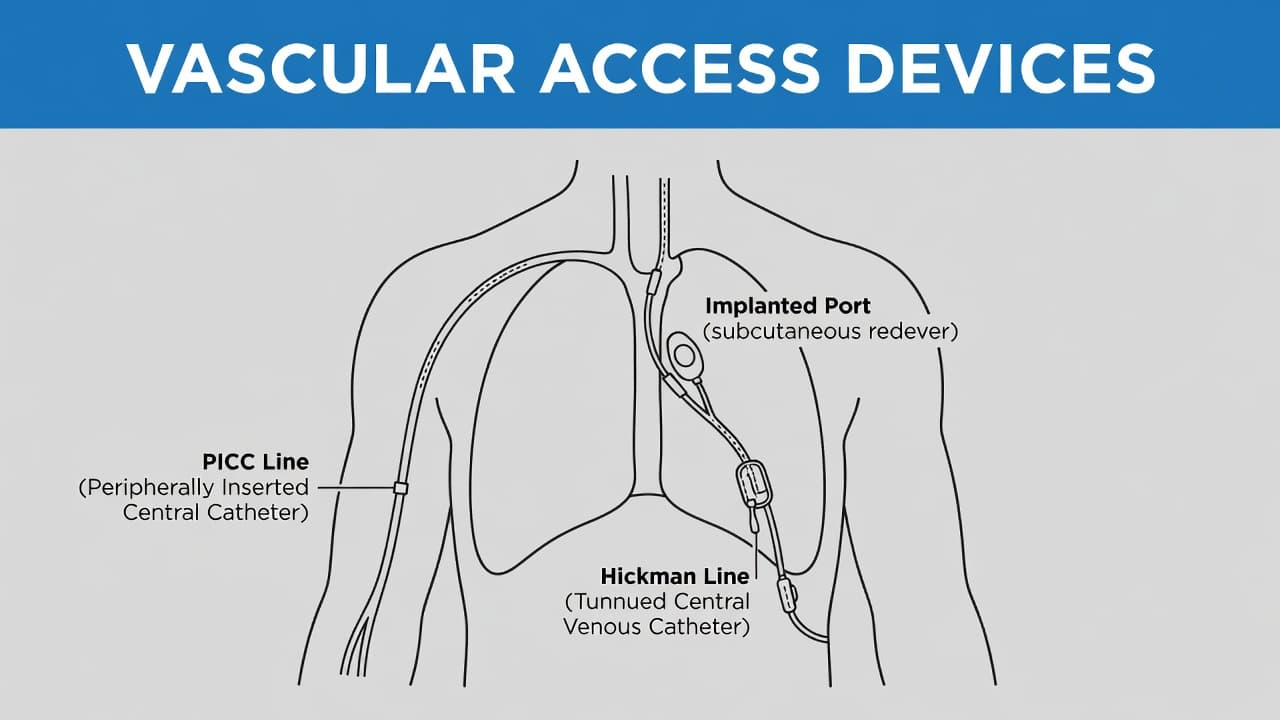
A simple look at where each device sits.
An implanted port is a small device placed under the skin, typically in the upper chest. A thin tube connects it to a large vein near the heart. When medical staff need to access it, they place a special needle through the skin and into the center of the port.
A PICC line, or peripherally inserted central catheter, is inserted into a vein in the upper arm and threaded into a larger vein near the heart. A portion of the line stays outside the arm, so you must keep it covered and protected.
A Hickman line is a specific type of tunneled catheter. It enters a large vein and exits through the skin on the chest. It often features multiple lumens, which are separate internal channels, allowing your care team to administer different medications or draw blood through independent lines.
This quick comparison helps:
| Device | Where it sits | What you see outside | Often works best for |
|---|---|---|---|
| Implanted port | Under the skin, usually chest | Nothing when not in use | Long-term treatment with breaks between visits |
| PICC line | Vein in upper arm | Tubing from the arm | Weeks to months, quick placement, no surgery |
| Hickman line | Tunneled under chest skin into a large vein | One or more chest tubes | Frequent access, repeated blood draws, intensive treatment |
The biggest day-to-day difference is simple: an implanted port hides under the skin, while a PICC line and a Hickman line stay outside the body.
That one fact shapes your routine regarding bathing, clothing, sleep, body image, and the amount of home care you must perform.
Why some people choose a port
An implanted port often makes sense when treatment will last a long time, but you will not need IV access every single day. Many people appreciate that nothing hangs outside the body between visits. After the surgical site heals, you may forget the device is there for long stretches of time.
That hidden design changes daily life. Showering is usually easier when the port is not accessed. Clothing choices feel simpler, and many people like that kids, pets, and seat belts are less likely to snag anything.
Choosing an implanted port can be a good fit for people who want less weekly line care at home. While these devices still need maintenance, including flushing on a schedule when not in use, the routine is often lighter than it is with an external line.
There are tradeoffs to consider. A port usually requires a placement procedure, which is typically performed in interventional radiology under local anaesthetic. Each treatment session starts with needle sticks to access the device. If you are sensitive to needles, that process matters. Some people use numbing cream, and many say that helps significantly.
A port can also leave a small bump under the skin. For some, that bump feels reassuring. For others, it feels like a constant reminder of their diagnosis. Both reactions are completely valid.
If your treatment comes in cycles, with days or weeks between visits, a port often feels like the least intrusive option. It is there when you need it, and it stays out of the way when you do not.
When a PICC line or Hickman line makes more sense
Sometimes a hidden device is not the most practical option. If your medical team needs frequent access, daily treatment, or several types of IV care, a PICC line or Hickman line may fit your needs better.
A PICC line is often the quick-start choice
A PICC line can often be inserted without surgery, which is a major advantage when treatment needs to begin right away. The placement is usually straightforward, and the removal process is simple as well.
For shorter or medium-length treatment plans, a PICC line acts as a convenient bridge. Nurses can use it for infusions, and they can often draw blood from it to spare you repeated needle sticks. The main trade-off is the daily maintenance. You must protect the dressing, ensure the line receives regular flushing, and be mindful of your arm when showering, sleeping, or dressing to avoid accidental tugging. While some people adjust well to this routine, others find the arm location intrusive, especially if they work with their hands or prefer not to be reminded of their treatment between visits.
A Hickman line is often the workhorse
A Hickman line is a central venous catheter that typically enters through the internal jugular vein and stays in the chest, exiting through the skin. Because it remains external, your medical team can access it without placing a needle into your skin each time, which is a significant relief for many patients.
A Hickman line is frequently the preferred choice for intensive treatments, such as a stem cell transplant, where patients require complex care, multiple infusions, and frequent blood draws. Because it allows for easy, multi-channel access, it is a reliable workhorse for ongoing, heavy-duty treatment. Like the arm-based options, a Hickman line requires consistent dressing changes and regular flushing to remain sterile. The visible tubing does mean you must remain aware of the site during sleep, exercise, and everyday movement.
Ultimately, the decision is not about which device is the most advanced, but rather which line best suits the daily rhythm of your specific care plan.
The daily life questions that matter most
This is the part many people wish someone had talked through sooner. Your line does not live on a chart. It lives on your body, and the choice between these options often comes down to your personal quality of life.
Maybe you are asking quiet questions. Will I be able to sleep on my side? Will my child hug me and hit the sore spot? Will I feel less like myself with tubing on my chest or arm? Will a port bump make me feel watched in the mirror? These are not small questions. They are treatment questions too.
Here are a few good ones to ask your team before you decide:
- How long do you expect I will need this line?
- How often will you use it for treatment or blood draws?
- What is the complication rate associated with this specific device?
- What care will I need to do at home each week, such as flushing the line?
- Can I shower, exercise, and sleep normally with it?
- What problems should make me call the medical team right away?
When monitoring your device, it is important to understand the risks. Watch for warning signs like redness, swelling, drainage, fever, or chills, as these can indicate an exit site infection or a more serious catheter-related bloodstream infection. You should also be aware of risks like venous thrombosis, mechanical failure, or issues such as an inability to aspirate blood, which requires immediate attention from your care team. Any sudden discomfort or trouble flushing the line deserves a quick check to prevent a potential bloodstream infection.
Your line is not a test of courage. It is a tool meant to make treatment safer and more manageable.
There is also an emotional side that does not fit neatly into a pamphlet. Some people in remission feel joy when a line comes out. Some feel exposed, as if the device had become part shield, part witness. Both feelings make sense.
If you want plain-language support while you sort through choices like this, compassionatevoices.org offers educational materials for people living with Cancer and other life-threatening diseases.
Frequently Asked Questions
Can I shower or swim with these devices?
You can typically shower with a port once the incision has healed, though external devices like PICC and Hickman lines require specialized waterproof covers to keep the site dry and prevent infection. Swimming is generally discouraged for all these devices due to the high risk of introducing bacteria into the bloodstream.
Is one device more painful than the others?
While the placement procedure is generally well-managed with local anesthesia, each device has different comfort factors. A port avoids external tubing but requires a needle stick for every access, whereas PICC and Hickman lines avoid needle sticks but require diligent care of the external exit site to prevent discomfort or tugging.
How long can these lines stay in place?
These devices are designed for varying timelines; PICC lines are often used for weeks to a few months, while ports and Hickman lines can remain in place for much longer durations, potentially months or even years depending on your treatment plan. Your medical team will monitor the site regularly and determine when the device is no longer necessary or needs to be replaced.
Can I exercise while I have one of these lines?
Most medical teams encourage light movement, but you should avoid heavy lifting, contact sports, or vigorous exercise that could pull on the tubing or disrupt the device site. Always check with your doctor to establish clear boundaries for physical activity based on the specific type of line you have and your overall health status.
Conclusion
The simplest answer is often the right one. An implanted port usually fits long-term treatment with less day to day upkeep, a PICC often fits shorter treatment and quick placement, and a Hickman often fits frequent, repeated access. Clinical research, including findings from the CAVA trial, provides helpful data on the efficiency and safety profiles of these devices to help guide your decision.
If the names still sound heavy, come back to one question: what will make daily life easier while you heal? Once that answer gets clear, the choice between port, PICC, and Hickman usually gets clearer too.