
One word from a scan report can rearrange your whole day. Recurrence, progression, and relapse sound close enough to blur together when you are scared, tired, and waiting for answers. It is common to feel overwhelmed by the subtle distinctions of recurrence vs progression vs relapse.
But they do not mean the same thing. The difference can shape treatment choices, follow-up plans, and how you make sense of where you are in your cancer experience. Let us slow it down and put each term into plain language.
Key Takeaways
- The Core Distinction: The primary difference depends on whether the cancer had previously achieved remission. Recurrence and relapse describe cancer that appeared gone and then returned, while progression describes cancer that remained active and worsened.
- Terminology by Cancer Type: While recurrence and relapse are clinically similar, recurrence is most often used for solid tumors, whereas relapse is the preferred term for blood cancers.
- Progression Explained: Cancer progression does not mean treatment failed permanently; it indicates that the cancer has developed resistance to the current approach, often signaling a need to pivot to new therapies or clinical trials.
- Ask for Clarity: Medical terms can be imprecise; always prioritize asking your care team about the specific nature of the change, the goal of the next phase of treatment, and how the findings affect your long-term outlook.
The plain-English difference between these terms
These words all describe change, but they answer different questions. Did the cancer go away and then return? Did it stay present and start growing? When evaluating changes seen on imaging scans, did your care team choose a word that fits your cancer type more than your exact situation?
Many oncologists and your cancer care team use the same basic split you can see in the American Cancer Society’s explanation of recurrence and progression. The wording may vary a little from one clinic to another, but the core meaning stays steady.
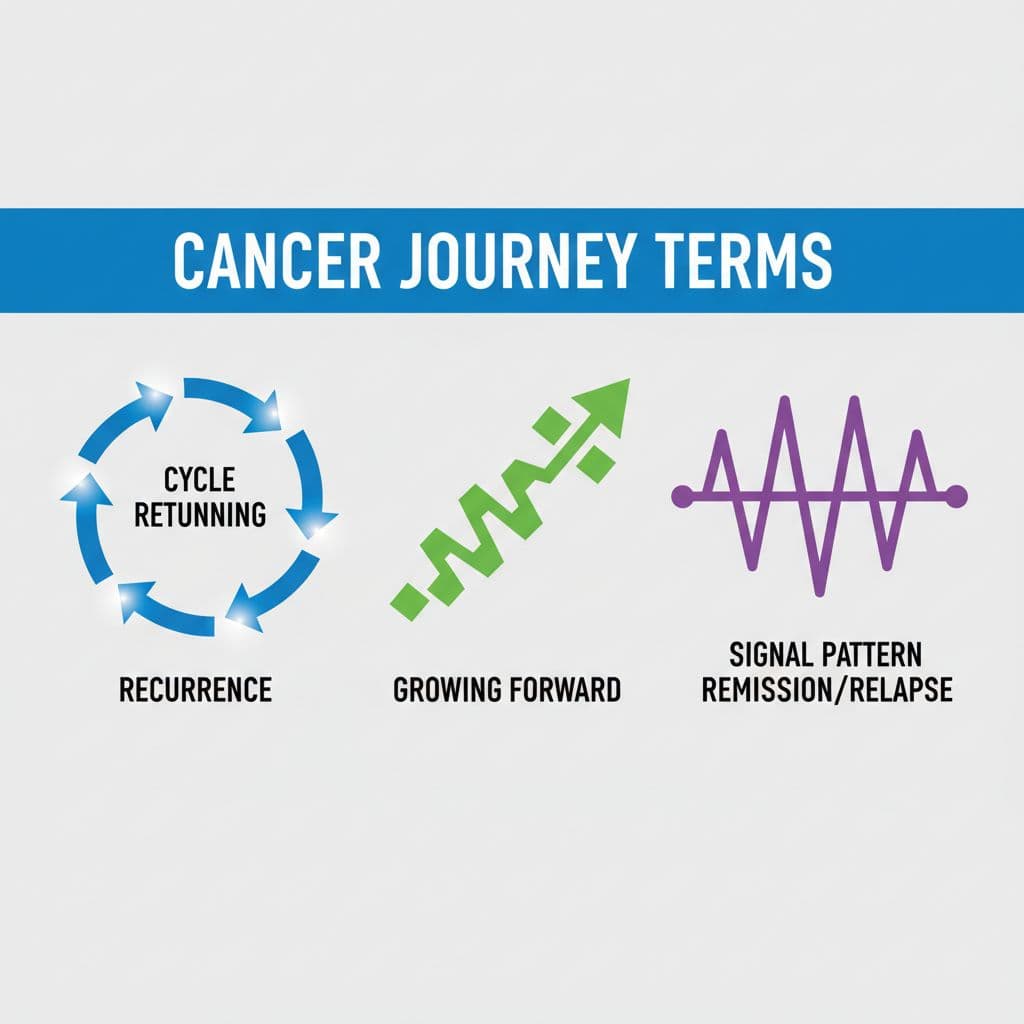
Here’s the quickest way to sort them out.
| Term | Plain-English meaning | Often used most |
|---|---|---|
| Recurrence | Cancer came back after it seemed gone or quiet | More often with solid tumors |
| Progression | Cancer kept growing, spreading, or worsening | During treatment or monitoring |
| Relapse | Disease returned after improvement or remission | More often with blood cancers |
The biggest dividing line is simple. If the cancer looked gone, or dropped into remission, and then showed up again on your imaging scans, doctors usually mean recurrence or relapse. If the cancer never fully left and now looks worse during the care team monitoring process, doctors usually mean progression.
That sounds tidy on paper. Real life feels messier. A doctor may use one word out of habit, another because of cancer type, and a third because of what the scan shows. So the word matters, yes, but the question underneath it matters more.
Recurrence means the cancer came back after remission
A cancer recurrence happens after a period when the cancer seemed gone, or quiet enough that your team could not find signs of it. Sometimes doctors call that complete remission, a state where there is no visible evidence of disease. However, tiny amounts of cancer cells may have remained hidden during this time. Then, later, a scan, blood test, or physical discovery points to the disease again.
Think of a fire that looked out. No flames. No smoke. Then heat hidden under the ashes catches again. That is the basic idea behind recurrence. Because recurrence rates vary by cancer type, your specific outlook depends heavily on your unique diagnosis.
This return can show up in different ways. A local recurrence is when the cancer returns in the same place as the original tumor. A regional recurrence means it has appeared in nearby tissue or lymph nodes. A distant recurrence occurs when the disease has spread to a completely different part of the body. The location matters because it changes your treatment goals, but the core definition remains the same: the cancer returned after a stretch when it appeared to be gone.
This is one reason follow-up care matters so much after treatment. If you are moving into remission, it helps to request a survivorship care plan. A good follow-up care plan spells out the signs and symptoms to watch for, when you need scans or blood work, and who to call if something changes.
A cancer recurrence also carries a heavy emotional weight. Many people say the fear of it follows them into every checkup. That fear makes sense. Relief and uncertainty often live in the same room after treatment ends, and you do not need to pretend otherwise.
Progression means the cancer is still active and moving forward
Cancer progression means the cancer is growing, spreading, or worsening, and it never fully went away in the first place. That point is easy to miss, but it is the whole difference.
Maybe treatment shrank the tumor for a while, but the next scan shows growth. Maybe the cancer stayed stable for months, then started showing a new spread of the disease. Maybe blood markers rise while you are still on therapy. In each case, the cancer remained active, and now it is doing more.
Picture a storm that never fully passed. The sky cleared a little, then darkened again. You would not call that a return. You would call it a worsening of the same storm. That is how cancer progression works.
Doctors may also use the phrase stable disease when the cancer has not shrunk much but has not grown either. Stable disease is not the same as remission, and it is not the same as progression. It means the cancer is present, but it is not moving in the wrong direction at that moment.
Hearing that your condition has progressed can feel brutal. You may think it means treatment failed and there are no options left. That leap is common, but it is not always true. Progression often happens because the cancer has become resistant to treatment, meaning the current plan is no longer controlling the disease well enough. When this occurs, there are often new treatment options to consider, such as changing medications, joining a clinical trial, adding radiation, or shifting to a different goal of care.
The word describes what the cancer is doing. It does not measure your effort, your courage, or your hope.
Relapse often means the disease returned after improvement
Relapse often means the disease improved, became undetectable, or moved into remission, and then came back. In plain speech, it overlaps a lot with recurrence, and you might even encounter the term recidivation in research or international oncology contexts.
The difference is often about context. If you live with leukemia, lymphoma, or myeloma, your team may say relapse where a solid tumor team might say recurrence. A plain-language explanation of relapse and recurrence puts the heart of it simply: signs of disease go away after treatment, then reappear.
Relapse shows up more often in blood cancers because those diseases use a slightly different vocabulary. Rather than focusing on a mass on a scan, doctors rely on blood tests, bone marrow findings, or molecular tests to track progress. A patient might also achieve a partial remission, where the cancer has shrunk but not completely disappeared, before experiencing a relapse. The language shifts according to how the disease is monitored.
You may have heard the word relapse outside cancer too, such as in addiction or mental health. The broad idea stays the same, as it describes something that improved and then returned. In oncology, however, the diagnostic criteria and treatment decisions behind that word are far more exact.
Do not rank the word in your head as automatically better or worse than recurrence. Often it is simply the terminology your specialty uses.
Ask, “Are you using relapse because the cancer returned after remission, or because that is the usual word for this cancer type?”
That one question can clear a surprising amount of fog.
When the words blur, ask better questions
Cancer is a life-threatening disease, so medical terminology can hit like a blow. When a doctor mentions recurrence, progression, or relapse, most people hear fear before they hear a formal definition. That is entirely human.
You do not need to memorize complex oncology terms to be an effective patient advocate for yourself. You do need clear answers. When the wording feels fuzzy or overwhelming, ask your care team these questions:
- Did the cancer go away entirely after your initial treatment, or has it remained present?
- What specific test showed the change, such as a biopsy, PET scan, CT scan, or MRI?
- Where is the cancer located now, and is this considered a recurrence or perhaps a new second cancer?
- How does this change the prognosis, and what is the current goal of treatment?
- If we adjust our approach, including options like chemotherapy or palliative care, how soon will we decide on the next steps?
- Does this situation alter our long-term outlook or the possibility of a clinical cure?
These questions bring the conversation back to what truly matters. They turn a loaded medical term into a practical explanation. It is also helpful to bring a family member with you, write down the answers, and ask the same question twice if you need to. A difficult appointment can make simple language disappear quickly, and there is no prize for catching every technical detail in one sitting.
If the uncertainty starts wearing down your sleep, appetite, or ability to think clearly, please know that support is available. You may also want to discuss advance care planning with your team to ensure your wishes are documented and respected. This guide on managing stress during cancer treatment offers practical ways to steady yourself between appointments. For more education and encouragement, compassionatevoices.org shares support for people living with cancer and other life-threatening diseases.
Frequently Asked Questions
Is cancer progression always a sign that the end of treatment is near?
Not necessarily. Progression means the cancer has become resistant to the current treatment, but it does not mean all options have been exhausted. It is common for oncologists to shift to new medications, different types of therapy, or clinical trials to regain control of the disease.
Can I use the terms recurrence and relapse interchangeably?
While they mean similar things in plain language—a return of disease after a period of improvement—they are used in different medical contexts. Doctors usually choose one based on the type of cancer you have, so it is best to ask your care team which term they prefer and why.
Does stable disease mean my cancer is in remission?
No, stable disease is distinct from remission. Remission means there is no visible evidence of cancer, while stable disease means the cancer is present but has neither significantly grown nor shrunk, representing a state where the disease is not currently advancing.
The clearest way to remember it
If the cancer went away and came back, think of it as cancer recurrence, or in many blood cancers, a relapse. If the disease never fully left and the status has worsened, think of it as cancer progression.
You do not have to hold all of this information perfectly in your head. Simply ask the question underneath every medical term: did it come back, or did it keep growing?
Using this type of plain language can help steady the room during difficult conversations. You deserve that level of clarity every time you speak with your care team.