

When a doctor mentions your ECOG performance status, it can feel like a heavy label that changes the atmosphere of the room. This common patient assessment tool is designed to provide a snapshot of how your health impacts your daily life. You might wonder if this number reflects how sick you are, how strong you feel, or what your future treatment will look like.
In reality, the process is much simpler than it sounds. Your medical team uses this scale as a practical way to gauge your physical function, and once you understand how that ECOG score is determined, the number often loses its power to intimidate you. It is merely a way for clinicians to describe how your condition affects your routine today, helping them better tailor your care to your specific needs.
Key Takeaways
- The ECOG performance status is a clinical tool used to assess how a disease affects your daily physical function, not a measure of your character, bravery, or value.
- On the ECOG scale, a lower number is better, with 0 representing full activity and 4 representing total disability.
- Doctors use this score as a guide to determine which treatments your body can safely tolerate, helping to balance potential benefits against the risk of side effects.
- Your score is not permanent or definitive; it is a snapshot of your current status that can change as your health improves or symptoms shift.
- Honesty during your assessments is crucial, as your medical team relies on an accurate picture of your daily function to tailor your care plan to your actual needs.
Why doctors bring up ECOG performance status
ECOG stands for the Eastern Cooperative Oncology Group, though you may sometimes hear it referred to as the Zubrod score. Regardless of the name, this performance status scale answers one practical question: how much are you able to do on a normal day?
That might sound simple. But when you are living with cancer, simple questions matter. Can you get dressed on your own? Are you up and around most of the day? Can you work, cook, walk, or even sit in a chair without needing to lie back down?
Your oncology team already looks at scans, lab work, and biopsy results to understand what the disease is doing. The ECOG performance status scale tells them how the disease is affecting your physical ability and overall functional status. The official ECOG scale focuses on self-care, activity, walking, and work. In plain English, it asks how much of your usual life you can still manage.
Doctors use this score frequently before starting chemotherapy, immunotherapy, radiation, surgery, or enrolling in clinical trials. They want to choose a cancer treatment that provides the most benefit while minimizing extra harm. A person may have a serious diagnosis but still function quite well. Conversely, another person might have a less advanced cancer yet still struggle with significant fatigue, pain, or weakness.
This kind of evaluation is not limited to cancer. In any life-threatening condition, or any illness that drains strength over time, doctors look at daily function because it provides an immediate, honest picture of how well a patient is doing.
How your daily activity turns into a score
Think of the score like a snapshot, not a biography. It does not measure your courage, your attitude, or your value. Instead, it measures how active you are and how much help you need today. Your oncology team uses the ECOG performance status grade 0 to 5 system to evaluate your functional impairment, which is particularly common when managing metastatic cancer. You may also hear your doctor mention the Karnofsky performance status, which is a similar but distinct scale used to measure your ability to perform daily activity.
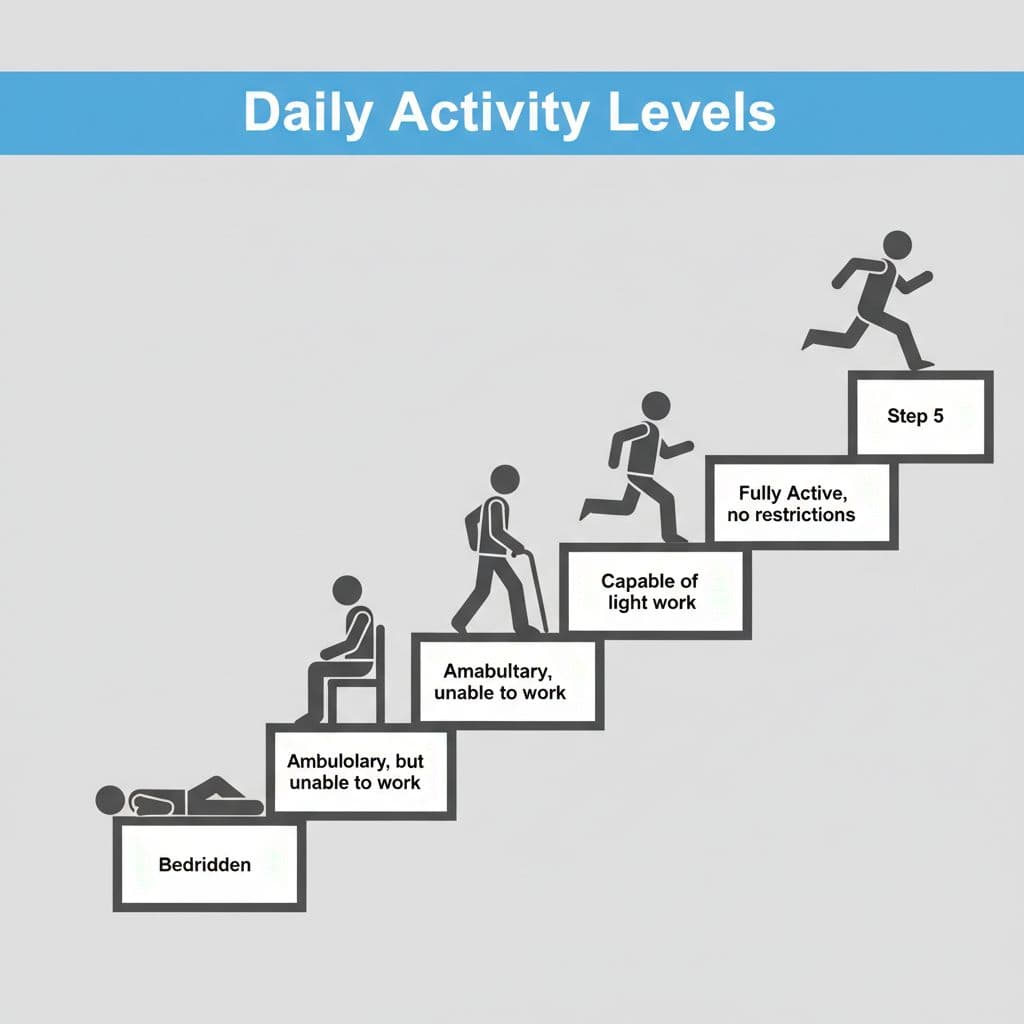
One detail trips people up: on this scale, lower is better.
A quick score guide
Here is the plain-English version of the scale:
| ECOG score | What it usually means |
|---|---|
| 0 | Fully active, able to carry on all pre-disease performance without restriction. You are considered fully ambulatory. |
| 1 | Restricted in physically strenuous activity but ambulatory and able to carry out work of a light or sedentary nature; you may be symptomatic. |
| 2 | Ambulatory and capable of all self-care but unable to carry out any work activities; up and about more than 50 percent of waking hours. |
| 3 | Capable of only limited self-care; confined to bed or chair more than 50 percent of waking hours. |
| 4 | Completely disabled; cannot carry on any self-care; totally confined to bed or chair. |
| 5 | Death. This is part of the formal scale, though patients usually hear about scores 0 through 4. |
The takeaway is simple: the number describes function, not character. A 2 does not mean you are not trying. A 3 does not mean you have failed. It means your body needs more from you than it used to, and right now it cannot give as much back.
Two people with the same cancer can have different ECOG scores. A person in remission may still have numb feet, shortness of breath, or treatment-related fatigue and score a 1. Someone newly diagnosed may land at 2 or 3 because pain, weight loss, or weakness has already taken a lot out of them.
A review of performance status assessment makes this point in a more clinical way: the scale helps guide treatment, but different clinicians can score the same person a little differently. That does not make the tool useless. It means context matters.
What that score can change about treatment
This is where the number starts to feel heavy. If the ECOG performance status affects your treatment plan, does that make it a prediction of your future? Not exactly.
Doctors use this score as a vital prognostic factor to help estimate how much stress your body can safely handle. Some treatments, such as aggressive chemotherapy, ask a lot of your system. A physician will conduct a toxicity assessment to determine if your body can tolerate these strong interventions. If you are already in bed most of the day, a heavy chemotherapy plan may cause more harm than good. If you are still active and independent, that same treatment may be a reasonable option.
The score is a guide for treatment choices, not a verdict on your future.
Sometimes the number opens doors, and sometimes it narrows them. For instance, clinical research and clinical trials often require a score of 0 or 1 to ensure that participants can safely complete the study. When a score is higher, your doctor might choose a lower dose, a different drug, or a slower approach. In these cases, the focus often shifts toward palliative care to improve your quality of life, or perhaps a plan that prioritizes pain control, nutrition, and rehabilitation to help you get stronger before moving forward.
While the ECOG performance status helps doctors predict overall survival and median survival outcomes, it is never personal. This score does not ask how brave you are. It asks what your body can safely manage at this moment.
It also never stands alone. Your medical team looks at your symptoms, blood counts, organ function, and weight changes alongside your personal goals. While the score is a critical piece of the puzzle, it never tells the whole story.
Why the number can change, even quickly
Your ECOG performance status can move up or down in a short time. A rough week involving dehydration, infection, uncontrolled pain, poor sleep, or difficult side effects from cancer treatment can lower your score. Conversely, effective symptom control or a therapy that starts working can improve it.
That is why honesty matters so much during your patient assessment. Many people try to sound stronger in the exam room. Who could blame them? You want treatment and you want hope. You do not want a number to close a door. But if you say you are doing fine when you are barely making it through the day, your team cannot adjust the plan to fit your real life.
If stress and fear have started to wear down your ability to function, that matters too. Emotional strain often manifests in the body. These practical ways to reduce treatment-related anxiety can help, but your care team still needs the full picture of your ECOG performance status to provide the best support.
A few questions can make the conversation clearer:
- What score are you giving me today?
- What in my day-to-day life led to that score?
- Is this coming from the cancer, side effects, or something else?
- What could help improve my function before the next decision?
Those questions matter during treatment, but they matter after treatment too. Even in remission, some people do not bounce back right away. Strength, stamina, sleep, memory, and confidence may return slowly. A guide to survivorship care planning can help you track what still needs support after active treatment ends.
A helpful number, not a measure of your courage
Numbers have a way of sounding final. This one is not.
You might hear an ECOG performance status score and worry that it suggests you are getting worse or that your medical team views you as weak. However, the scale does not measure your willpower. It does not count the immense effort it took to shower, answer a text, or show up for another appointment when every part of you wanted to stay home.
What does courage look like in cancer care? Sometimes it looks like walking a hallway while hooked to an IV pole. Sometimes it looks like telling the truth about how bad your fatigue has become. Sometimes it looks like accepting help when you need it most.
If you remember one thing, let it be this: your ECOG performance status is simply a clinical tool. It is a useful way for doctors to gauge your functional status, but it remains just a measurement. This score can help your team choose safer care and explain why one treatment plan fits while another does not, but it cannot measure your spirit.
If you want more plain language support on cancer and other life threatening diseases, compassionatevoices.org offers information that speaks to both the medical side and the human side.
Frequently Asked Questions
Why is my ECOG score lower than someone else’s with the same diagnosis?
Every person experiences illness differently based on their unique biology, symptom management, and the specific toll a condition takes on their body. Two people can have the same diagnosis but different levels of fatigue, pain, or weakness, which directly impacts their functional status score.
Does a high ECOG score mean I have no treatment options?
Not at all, though it does change the approach your medical team might take. If you have a higher score, your doctor might opt for lower doses, different medications, or a focus on palliative care to improve your quality of life before moving forward with more intensive interventions.
Can I improve my ECOG score over time?
Yes, the score is not a fixed verdict and can improve as you receive effective symptom control or as your body responds to therapy. Factors like pain management, improved nutrition, and physical rehabilitation can sometimes help you regain stamina and shift your functional status.
Is it okay to be honest if my status has declined?
It is vital to be completely honest with your team, even if you fear that admitting to weakness will limit your treatment choices. Providing an accurate assessment prevents your doctors from prescribing treatments that might cause more harm than good and allows them to adjust your care to better support you.
Conclusion
When a number appears during an already difficult medical appointment, it is natural to feel some apprehension. However, understanding the ECOG performance status can help clear up some of that uncertainty. This tool allows your healthcare team to gauge how your illness impacts your daily function, and on this scale, a lower ECOG score indicates that you are maintaining more of your regular activity.
While this data is essential for guiding treatment decisions, it does not tell your entire story. Your personal symptoms, long term goals, support network, and recovery process are just as significant.
Most importantly, the score is not a definition of who you are. It is simply a snapshot used to help your team provide the best care possible. By keeping this in perspective, you can focus on what truly matters: improving your quality of life.