
When you first hear “targeted cancer therapy,” also called precision medicine or personalized medicine, it can sound like one more medical phrase dropped into an already crowded room. But the idea is simpler than it sounds. Cancer is a life-threatening disease where cancer cells behave differently from normal cells, so treatment often has to be personal.
Targeted cancer therapy tries to find a weakness in a cancer cell and hit that weakness. Not every tumor has one, and not every drug works the same way. Still, when there is a match, this kind of treatment can change the path ahead.
Key Takeaways
- Targeted cancer therapy attacks specific weaknesses in cancer cells, like mutations or proteins, to block growth while sparing healthy cells more than chemotherapy often does.
- Biomarker testing on tumor tissue or blood is essential to match the right drug to your cancer’s biology, as not every tumor has a target.
- It’s a family of treatments, not one drug; what works for EGFR lung cancer won’t for HER2 breast cancer, and combinations with other therapies are common.
- Side effects like rash or fatigue happen, cancer can develop resistance over time, but re-testing and clinical trials keep options open.
- A good match matters more than the name—testing guides honest choices and real hope.
What targeted therapy means in real life
Think of cancer cells as houses with broken alarm systems and stuck gas pedals. They keep getting signals to grow, divide, and ignore the usual rules. Targeted therapy looks for one of those broken parts in cancer cells and tries to block it.
That is the heart of it. Instead of attacking all fast-growing cells the way chemotherapy often does, targeted drugs look for a specific marker, mutation, or protein that helps cancer cells survive, helping to protect healthy tissue compared to traditional treatments. There are two main types: small-molecule drugs and monoclonal antibodies. The National Cancer Institute’s fact sheet on targeted therapy explains it in similar terms: these treatments go after the machinery that drives cancer growth.
Some targeted drugs are pills. Others go through an IV. Some act as signal transduction inhibitors to block growth messages inside the cell. Some stick to a marker on the outside. Some help cut off the blood supply a tumor needs. These targeted drugs can also trigger apoptosis, programmed cell death, in cancer cells. Same category, different jobs.
This is why “targeted therapy” is not one treatment. It’s a family of treatments. A person with EGFR-positive lung cancer may get one kind of drug. A person with HER2-positive breast cancer may get another. Someone with leukemia or a cancer driven by the BRCA mutation may get a different option again.
But the word “targeted” can fool people. It sounds neat and exact, almost like a laser. Real life is messier. Healthy cells can share some of the same features, so side effects still happen. And if the cancer does not carry the target, the drug usually won’t help much.
A targeted drug can only work if your cancer has something real for it to hit.
That is why testing matters so much.
How doctors know whether targeted therapy fits your cancer
Doctors usually do not pick a targeted drug based on the tumor’s location alone. They look at its biology. That often means biomarker testing, which is a lab test on tumor tissue, blood, or both.
Why does that matter? Because two people can both have the same kind of cancer on paper and still need different treatment. One lung tumor may carry an EGFR gene mutation. Another may not. One breast cancer may overexpress the HER2 protein. In colorectal cancer, BRAF gene mutations might respond to BRAF inhibitors. Same broad name, different engine under the hood.
This is where plain English helps. Biomarkers are clues. They tell your team whether a drug has a real chance of matching your tumor. Cancer Research UK’s guide to targeted cancer drugs makes this point clearly: these drugs are built to act on the differences that help cancer grow.
If testing shows a match, targeted cancer therapy may move high on the list. If it does not, that is still useful information. It saves time. It helps your team look at chemotherapy, immunotherapy, hormone therapy, surgery, radiation, or a clinical trial instead.
As of May 2026, this matching process keeps getting better. More cancer centers use broader biomarker testing, and blood-based “liquid biopsy” tests can sometimes help track changes when a tumor starts to adapt and develop drug resistance. Doctors are also using targeted treatments earlier in some cases, including before surgery, not only after other treatments fail.
That last part matters because cancer cells can change over time, leading to drug resistance. A drug may work well for months or years, then stop. If that happens, it does not mean you did something wrong. Cancer cells can develop new gene mutations. The lock changes shape, and the old key no longer fits.
That can be heartbreaking. It can also be a moment for re-testing, not hopelessness. Sometimes another target appears. Sometimes another treatment path opens.
How targeted therapy compares with chemotherapy and other treatment options
One of the most common questions is simple: “So, is this better than chemotherapy?” Sometimes the honest answer is yes. Sometimes it is no. Often, it is not a contest at all. These treatments do different jobs.
Chemotherapy often works by killing fast-growing cells. That can be effective, but it can also affect healthy fast-growing cells, like those in hair follicles, the mouth, and the gut. Targeted therapy tries to act with more selectivity, though it still has risks and side effects.
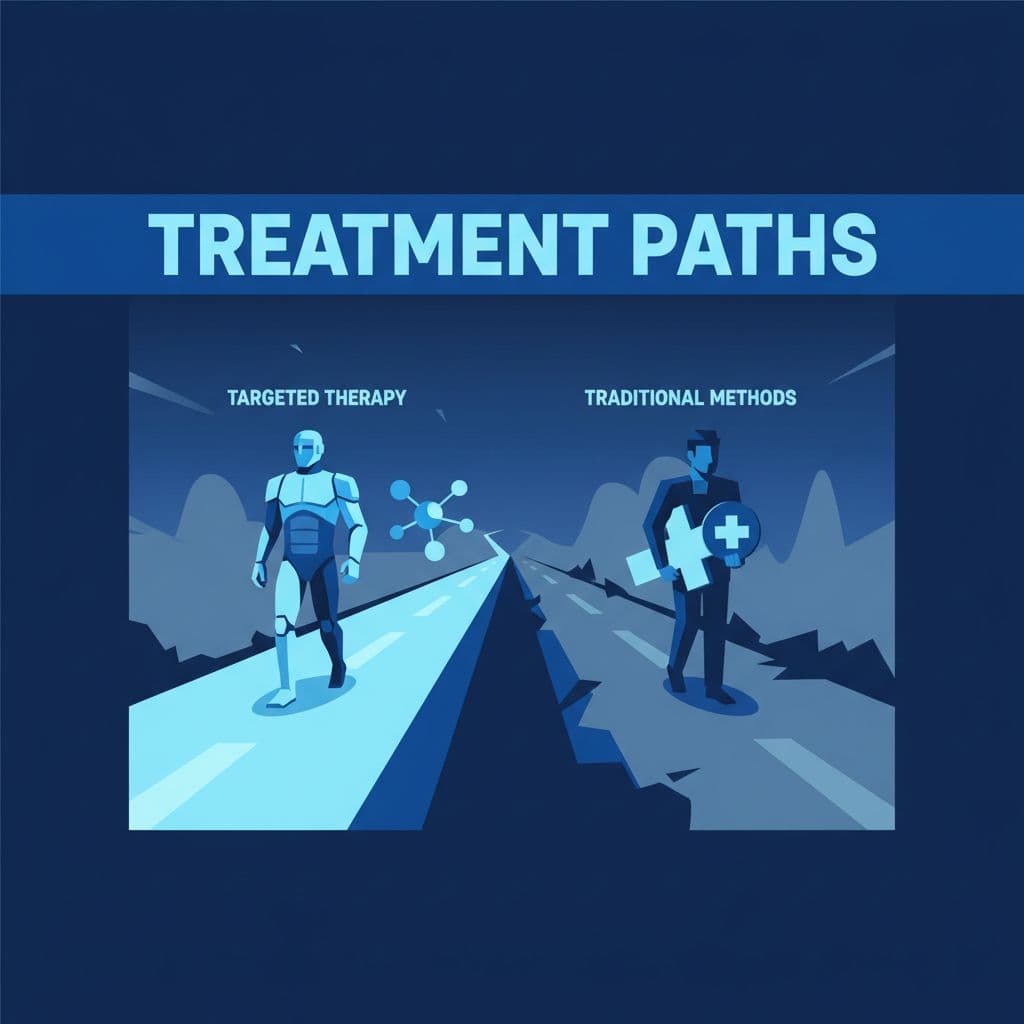
This quick comparison helps put the differences in place. For instance, angiogenesis inhibitors are a type of targeted therapy that block the growth of blood vessels that feed tumors.
| Treatment | Main idea | What doctors need first | Usual role |
|---|---|---|---|
| Targeted therapy | Hit a specific mutation or protein (e.g., PARP inhibitors targeting DNA repair) | A matching biomarker | Often used when testing shows a clear target |
| Chemotherapy | Kill fast-growing cells | Cancer type and stage | Works across many cancers, sometimes with other treatments |
| Immunotherapy | Help the immune system attack cancer (e.g., checkpoint inhibitors) | Tumor features that suggest benefit | Used in some cancers alone or in combination |
| Surgery or radiation | Remove or destroy a known area | A tumor that can be treated locally | Best for local control, sometimes with drug treatment |
The takeaway is simple: these tools often work together in combination therapy.
A person may get targeted therapy and still need surgery. Another may start with chemotherapy, then switch. Someone else may take a targeted drug with immunotherapy. In 2026, doctors are using some targeted treatments before surgery more often than they did a decade ago, because shrinking a tumor early can improve the next step in combination therapy.
The American Cancer Society’s explanation of how targeted therapy works also helps clear up another common myth. Targeted therapy does not automatically mean milder treatment. It means more specific treatment. Specific is not the same as gentle.
That is hard, but it is important. Hope needs honesty.
What treatment may feel like, and what comes after
For some people, targeted cancer therapy fits into daily life more easily than older treatments. A pill at home may sound less disruptive than long infusion days. Still, “easier to take” does not always mean easy to live with.
Side effects depend on the targeted drugs. Some people deal with side effects such as rash, diarrhea, fatigue, mouth sores, high blood pressure, liver changes, or swelling. Others feel okay for weeks, then hit a rough patch with intensified side effects. Your team usually watches labs, scans, blood pressure, and symptoms closely because the details matter. If side effects prove challenging, discussing clinical trials for newer options can be worthwhile.
If you are in treatment now, stress can build in ways that are hard to explain to people outside the room. Waiting for scan results, wondering if the drug is still working, carrying fear while trying to act normal, it adds up. Support counts. If that strain feels heavy, this guide on managing stress during cancer treatment offers practical ways to steady yourself.
There is another part people do not talk about enough: what happens if treatment works.
If targeted therapy helps you reach remission, or even long-term stable disease, relief may arrive with fear right behind it. You may feel grateful and terrified in the same hour. That is common. After treatment, requesting a survivorship care plan informed by precision medicine can help you keep track of follow-up visits, late side effects, and the next steps your body may need.
And if your emotions feel messy in remission, that does not mean you are doing it wrong. It means you are human. For broader education, encouragement, and reflection from people who understand cancer and other life-threatening diseases, compassionatevoices.org is a steady place to return to.
Targeted therapy can bring real hope, including through participation in clinical trials. It can also bring long stretches of uncertainty. Both things can be true at once.
Frequently Asked Questions
What is targeted cancer therapy?
Targeted therapy finds and blocks specific features that help cancer cells grow, like broken signals or proteins, using pills or IV drugs. Unlike chemotherapy’s broad attack on fast-growing cells, it aims for precision to protect healthy tissue. It’s personalized, but only works if your tumor has the right target.
How do doctors decide if targeted therapy is right for me?
They use biomarker testing on tumor tissue or blood to check for matching mutations or proteins, like EGFR or HER2. Two people with the same cancer type might need different paths based on biology. No match means looking at chemo, immunotherapy, or trials instead.
Is targeted therapy better than chemotherapy?
It depends—targeted therapy is more selective but not always milder or superior; chemo kills fast-growing cells broadly. They often team up in combinations, and targeted drugs work best with a clear biomarker match. Specific isn’t the same as gentle.
What side effects should I expect?
Common ones include rash, diarrhea, fatigue, mouth sores, or high blood pressure, varying by drug. Your team monitors closely with labs and scans. If tough, discuss adjustments or trials.
What happens if the cancer stops responding?
Cancer cells can mutate and develop resistance, but that’s not your fault—re-test to find new targets or paths. Liquid biopsies help track changes, and earlier use or combinations are improving outcomes. Hope lies in adaptation, not giving up.
Conclusion
Targeted cancer therapy is not magic, but it is not mystery either. It is a treatment built around one clear idea: find a feature that helps the cancer cells grow, then try to block it.
That is why testing matters, and why one person’s treatment may look nothing like another’s. If you remember one thing, let it be this: a good match matters more than a dramatic name.
When the words feel heavy, come back to the basics. What is the target, how are they testing for it, and what happens if this drug works, or stops working? Those questions can bring a little light back into a hard room. Precision medicine ensures the treatment journey stays trained on those cancer cells.