
What does courage look like on an ordinary Tuesday with chemo port care in the mix? Sometimes it’s not a big speech or a brave face. It’s the small things: peeling back a dressing gently, choosing patience over panic, and calling your nurse even when you worry you’re “bothering” them.
If you’re living with cancer, in treatment, or in remission, a port (also known as an implanted port or central venous catheter) can feel like both a helper and a constant reminder, providing reliable bloodstream access for treatments. This guide walks through home care basics, shower tips, what “flushing” really means, and the warning signs that deserve quick attention.
Know your port and what “normal” looks like for you
A chemo port (often called an implanted port, port-a-cath, or mediport) sits under the skin, usually on the chest. Placed by interventional radiology, it can look like a small bump on the outside. On the inside, it connects to a vein through a thin tube. For many people, the implanted port becomes the steady doorway for treatment, blood draws, fluids, or scans.
In day-to-day life, “normal” can be wonderfully boring. Many ports aren’t painful once healed. You may feel pressure if you press on it, or mild tenderness after it’s accessed (when a Huber needle is placed through the skin into the port). Some days you’ll forget it’s there, until a seatbelt crosses your chest or you catch your reflection and remember.
Home care starts with one simple skill: noticing change, especially during immediate post-placement healing at the incision site. Try a quick check once a day, like you’d glance at a healing bruise. Look for new redness and swelling, drainage, skin that feels hot, or steri-strips that have loosened. Touch lightly with clean hands. If your port is accessed, check that the dressing edges are sealed and dry.
It can help to keep one trusted, practical resource bookmarked. The University of Michigan’s home guide covers daily protection, troubleshooting, and safety reminders in plain language: Care of the port in the home. When your brain is tired, clear instructions matter.
Chemo port care at home during showers (without fear or fuss)
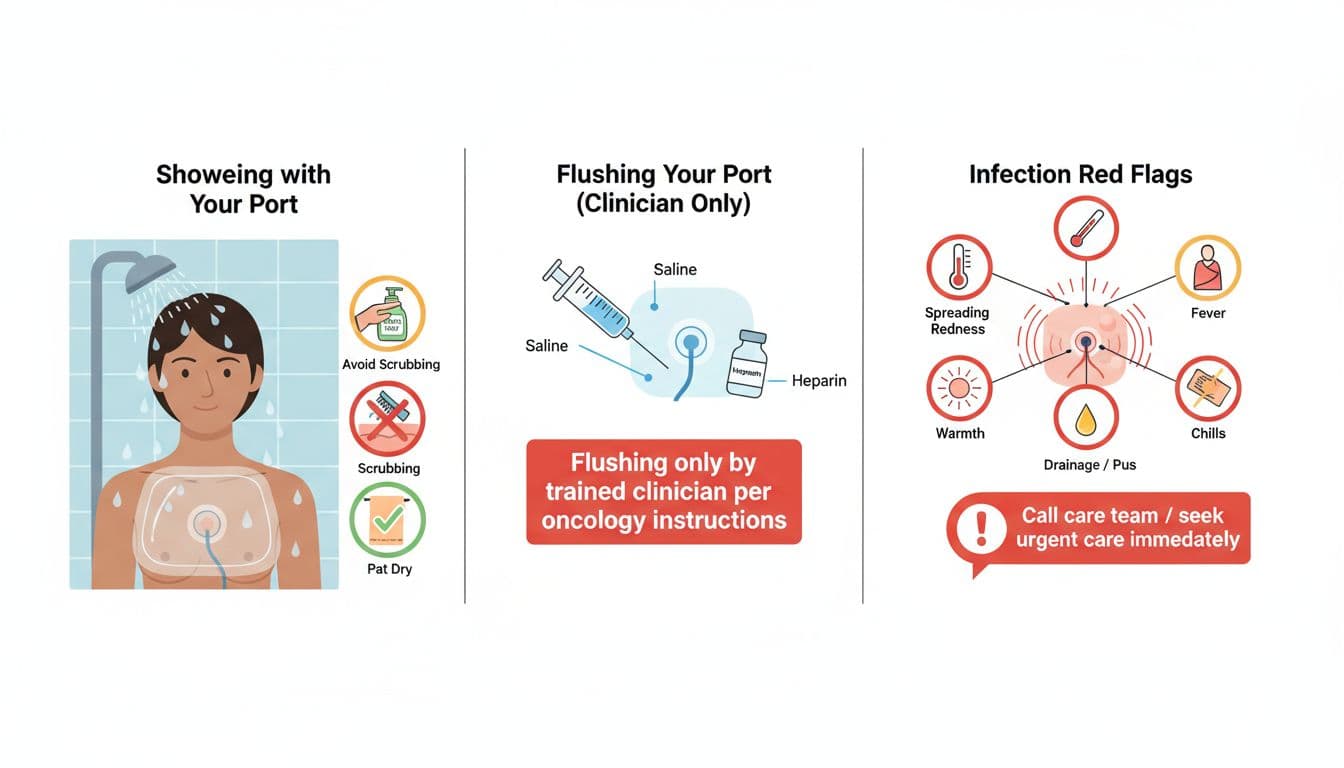
Showering can be surprisingly emotional. Water is soothing, but it also asks you to trust your routine. The right approach depends on whether your port is accessed (needle in place with a dressing) and how recently it was placed.
Many care teams allow normal showers once the incision is healed and the port isn’t accessed, but rules vary. If your port is accessed, you usually need to keep the dressing dry, because wet dressings can loosen and let germs in. If you’re unsure what applies to you today, use your clinic’s instructions as your north star. This patient handout can help you compare your plan with standard guidance: Implanted port care instructions.
Here’s a simple shower routine that works for many people (and still leaves room for your team’s specifics):
- Cover if needed: If you have a dressing, use the waterproof dressing your nurse recommends, and press the edges down well.
- Use gentle soap: If recommended by the care team prior to access or post-procedure, take a Hibiclens shower. Let suds run over the area. Don’t scrub the incision site.
- Keep water pressure soft: Aim the spray away from your chest when you can.
- Pat dry, don’t rub: Use a clean towel. If there’s a dressing, dry around it carefully.
- Check the dressing edges: If it’s lifting, wrinkled, or damp underneath, call your care team for a dressing change.
Avoid soaking in tubs, hot tubs, or pools until your team says it’s safe, especially after a new port placement or any skin irritation. Also avoid heavy lifting if the port was recently placed. Think of healing skin like wet paper; it tears more easily than you expect.

Flushing basics: what it is, what it isn’t, and what to ask
“Flushing” an implanted port sounds simple, like rinsing a straw. The goal is to maintain catheter patency and reduce the chance of clots or buildup. Depending on your care plan, flushing may be done with normal saline, sometimes followed by a medication like heparin. This sterile procedure involves cleaning the port septum with an antiseptic solution before pushing normal saline through to clear the line. The timing varies; some ports are flushed during clinic visits, others on a schedule when not in use.
The most important truth is also the most reassuring: don’t improvise flushing. Many people never flush their port at home. If home flushing is part of your plan (for example, with home infusion), your oncology team will train you, provide supplies, and give written steps. If you were not trained, treat flushing as “not your job.”
If you want clarity without getting lost in details, ask your nurse these questions and write the answers down:
- How often should my port be flushed when not in use?
- Who is allowed to flush it in my situation (clinic, home nurse, me)?
- What should I do if an appointment gets delayed?
- What symptoms mean the port might be blocked or irritated?
For a plain-language overview of what to expect at home with an implanted port, including general care reminders, see: implanted port aftercare guidance.
Infection red flags: the signs that deserve a fast call
Fear of signs of infection can creep in quietly. A port provides direct bloodstream access close to a major vein, so it’s smart to take changes seriously, without spiraling. Think of it like a smoke alarm. Most days it’s silent, but when it sounds, you act.
Call your care team the same day if you notice signs of infection:
- Redness and swelling that’s spreading around the port or along the line path
- Warmth or increasing pain at the incision site
- Pus or drainage, especially cloudy fluid or bad smell
- Unexplained fever or chills, even if the port site “looks fine”
- A wet, loose, or dirty dressing when the port is accessed
Seek urgent care right away (or follow your clinic’s emergency plan) if you have unexplained fever with shaking chills, confusion, shortness of breath, chest pain, or feel suddenly very unwell. Also get help quickly for neck or arm swelling on the port side, or new severe headache, because those can signal a serious circulation problem.
If you’re worried you’ll forget what to say on the phone, try this script: “I have an implanted port. Today I noticed (symptom). My temperature is (number). My last treatment was (date). What do you want me to do now?” Simple and direct is brave.
Closing thoughts you can carry into tomorrow
Chemo port care isn’t just medical. It’s a daily practice of attention, boundaries, and self-respect. You’re allowed to call. You’re allowed to ask for training. You’re allowed to treat a small change like it matters, because it does.
If you’re in remission, that courage still counts. The implanted port may be part of your story for a while, but while it simplifies the process for blood samples and intravenous fluids, it doesn’t get to narrate the whole thing. Keep your plan close, trust your eyes and instincts, carry a medical alert card to notify emergency staff about the device, and when something feels off, choose swift action over silent worry.