How can cancer look gone, yet your doctor still wants one more test? That question rattles a lot of people, especially when you have already carried enough fear.
Minimal residual disease, also known as measurable residual disease, refers to a tiny number of cancer cells that may still remain after treatment, even when scans or routine blood work look reassuring. While this concept is particularly important when managing hematological malignancies, the core idea is simple: look closer, earlier, and with more precision. That starts with understanding the terminology in plain language.
Key Takeaways
- MRD defined: Minimal residual disease (MRD) refers to a tiny number of cancer cells remaining in the body after treatment, often below the threshold of detection for standard scans like CT or PET.
- Precision tracking: Technologies such as next-generation sequencing, flow cytometry, and polymerase chain reaction allow doctors to identify individual cancer cells, providing a deeper look at treatment success than traditional imaging.
- Clinical utility: MRD status acts as a powerful biomarker that helps oncologists determine if therapy is working, guide decisions on continuing treatment, and identify potential relapses months before they cause symptoms.
- Not a crystal ball: While MRD results provide valuable information for risk stratification and monitoring, they are just one piece of the puzzle and do not replace the need for ongoing clinical judgment or symptom monitoring.
What minimal residual disease really means
Cancer can shrink so far that doctors cannot see it on a scan. That does not always mean every last cancer cell has disappeared. Minimal residual disease, often shortened to MRD, refers to those few remaining cells that hide below the level ordinary tests can detect. Sometimes, medical professionals may use the term measurable residual disease or even molecular residual disease to describe this same clinical phenomenon.
The words themselves can feel cold. Minimal sounds small. Residual sounds like a leftover scrap. But in medicine, tiny does not mean trivial. A few cells can still matter because they have the potential to grow, which influences your long-term relapse risk.
Think of it like putting out a fire. The flames are gone. The room looks calm. Still, one hot ember may remain under the ashes. MRD is that ember. Small, hard to spot, but important.
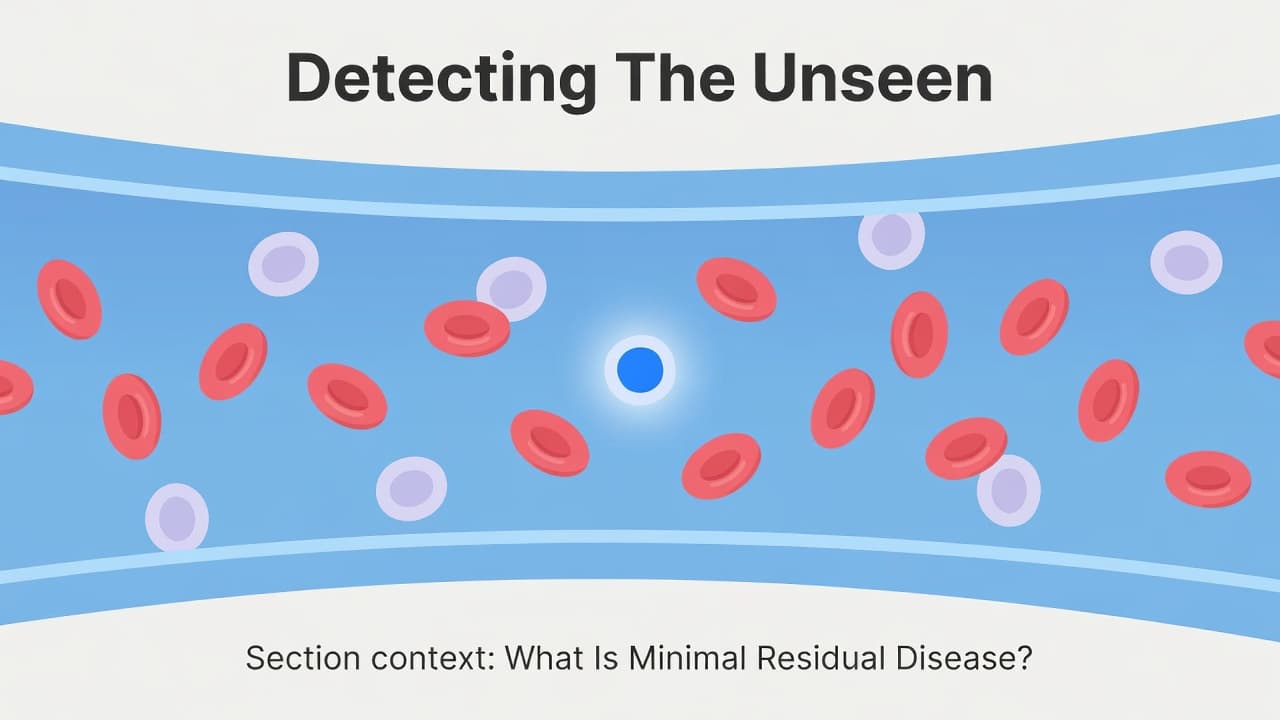
The NCI’s plain-language definition says minimal residual disease describes a very small number of cancer cells left in the body during or after treatment. MD Anderson’s MRD explainer says the same thing in everyday terms: some cancers leave behind a tiny trace that only more sensitive testing can find.
A clear scan can mean “no visible cancer.” It does not always mean “no cancer cells anywhere.”
That distinction matters. Cancer can return in a whisper, not a shout. MRD testing tries to hear that whisper early.
Not every cancer uses MRD testing in the same way. It is already a common part of care for several blood cancers, such as acute myeloid leukemia, acute lymphoblastic leukemia, and multiple myeloma. Achieving a status where these cells are undetectable, often called an MRD-negative state, is a key clinical goal after a patient reaches complete remission. Doctors also use it more often in some solid tumors, including colorectal cancer. For breast, lung, and some other types, researchers still study when the test helps most. So if your friend with a different cancer gets different advice, that is not a contradiction. MRD does not work like a broad screen for some other disease. It tracks your known cancer. The test has to fit the disease in front of you.
How doctors look for cells that hide
Once you understand the basic idea of minimal residual disease, the next question comes fast: how do doctors find something so small?
In 2026, many tests rely on a liquid biopsy. This approach often looks for circulating tumor DNA, which refers to tiny bits of genetic material shed by cancer cells into the bloodstream. For many blood cancers, doctors may also study blood cells directly or perform a bone marrow biopsy, because that is where those cancers typically reside.
A few technical terms may show up in your report. Techniques like polymerase chain reaction, flow cytometry, and next-generation sequencing are specialized lab methods used to search for microscopic cancer signals. While you do not need to master the science behind them, it is helpful to know that these tests demonstrate high sensitivity and specificity. By using advanced next-generation sequencing or highly sensitive flow cytometry, these tests can sometimes detect as few as one cancer cell among one million normal cells.
You may also hear the term MRD-negative when the test does not find leftover cancer at the limit of its detection. You may hear MRD-positive when it does. Because the sensitivity and specificity of these tools vary, the clinical utility of a result depends on the specific cancer and the platform used.
This quick comparison helps put testing in context.
| Test | What it can show | What it may miss |
|---|---|---|
| CT or PET scan | Tumors large enough to image | Tiny leftover cells |
| Standard lab work | Changes in blood counts or organ function | Small traces of cancer |
| MRD testing | Very small traces linked to a known cancer | Cancers that do not shed enough cells or DNA for the test |
Testing does not replace scans, exams, or your symptoms. It adds another layer of information.
Some testing is custom-made. A lab may use a tumor-informed approach, where they study your original tumor to create a personal genetic fingerprint. A tool like Clonoseq, which utilizes next-generation sequencing, is often used to track that specific fingerprint in your blood over time. Other tests use a standard panel that looks for common cancer clues without needing the original tumor sample. These often rely on polymerase chain reaction or specific panels for next-generation sequencing. Similarly, flow cytometry is frequently used to identify surface markers on cells to provide a clear picture of remaining disease.
That sounds almost futuristic, but the point is practical. If doctors can spot leftover cancer earlier, they may make better decisions sooner. In 2026, testing using methods like polymerase chain reaction, flow cytometry, and next-generation sequencing is standard care for several blood cancers and colorectal cancer, while researchers continue to study the best use for these tools in breast and lung cancers. Still, this testing is not a crystal ball. A negative result does not promise cancer will never return. A positive result does not mean visible relapse is happening today. Results need context, timing, and your oncologist’s judgment.
Why MRD matters during treatment and in remission
After a life-threatening disease, numbers can feel personal. One result can lift you for a week, while another can knock the wind out of you before breakfast. Minimal residual disease matters because it gives your care team deeper clinical utility than older tests may provide, often serving as a key indicator for overall survival.
If no minimal residual disease shows up after treatment, it suggests the therapy worked well. In some settings, this supports staying the course instead of adding more treatment right away. Conversely, if the test finds leftover cancer cells, your team may use that information for risk stratification to determine if you need closer monitoring, repeated testing, or a different next step.
Sometimes, these results help doctors decide whether to continue a drug, add treatment, or hold back to avoid unnecessary side effects. For patients undergoing a stem cell transplant, these tests are vital for evaluating the success of the procedure and managing long-term care. More treatment is not always better treatment, and finding the right balance is essential.
This is where remission becomes more layered than most people expect. You can be in remission and still have questions. You can have a clear scan and still hear your doctor talk about potential relapse risk. This is not your team moving the goalposts; it is your team trying to see the full picture of your health.
For some patients, these tests act like an early warning sign. Research shows that monitoring can detect returning cancer months before it shows up on imaging or causes symptoms. By identifying a higher relapse risk earlier, your team may improve your progression-free survival by opening a window for intervention before the disease grows. Ultimately, tracking these levels helps clinicians predict progression-free survival more accurately, allowing for a more tailored approach to your recovery.
But there is another side to this. More information can also bring more worry. Waiting for results can stir up the same fear you felt at diagnosis. If that is where you are, you are not overreacting; you are human.
This is why follow-up care needs structure, not guesswork. Ask your team what your result changes, what it does not change, and when they want to test again. If you are finishing treatment or living in remission, requesting a survivorship care plan can help you see the road ahead more clearly. Appointments, lab work, symptoms to watch, and who to call, all of that belongs in the plan.
Questions worth asking after an MRD result
When a doctor says “we found no minimal residual disease” or “we detected residual disease,” your mind may race ahead. Slow it down. You do not have to ask the perfect question. You only need the next honest one.
Start here if you feel stuck:
- What exactly did this test look for in my cancer? For example, did it use flow cytometry to identify specific markers, or did it use polymerase chain reaction to detect specific chromosomal translocations?
- How accurate is this test for my specific diagnosis, such as acute myeloid leukemia or multiple myeloma?
- Does this result change my treatment or follow-up plan according to the NCCN guidelines?
- When will we repeat the test to monitor my hematological malignancies?
- What symptoms should make me call sooner?
Those questions bring the conversation back to your life, not only the lab report. Whether you are being monitored for acute lymphoblastic leukemia or chronic myeloid leukemia, it helps to ask what the result does not mean. An MRD test is not a broad check for every other disease in the body. It is not a verdict on your future. It is simply one piece of evidence about your specific cancer, such as how it tracks certain chromosomal translocations or uses flow cytometry to measure disease burden.
If appointments make your mind go blank, bring a notebook or a trusted person. Ask for the result in writing. Hard news, and even good news, can blur together once you leave the room.
If you are in complete remission, the emotional part of this can feel harder than the medical language. Relief and fear often sit in the same chair. That is common. So is grief, even after good news. For support around life after reaching cancer remission, it helps to hear from people who know that survival is not a simple finish line, especially for those recovering from acute myeloid leukemia.
If you need a steady place to keep learning, compassionatevoices.org offers educational support for people living with cancer and other life threatening diseases. Facts matter. So does gentleness.
Frequently Asked Questions
If my scan is clear, why do I still need an MRD test?
Standard imaging like CT or PET scans can only visualize larger clusters of cancer cells, meaning they might miss microscopic traces. MRD testing is significantly more sensitive and helps detect these hidden cells to determine if you truly have no measurable disease left.
What does it mean to be “MRD-negative”?
Being MRD-negative indicates that the highly sensitive testing methods used by your medical team did not find any remaining cancer cells at the limit of detection. This is a common and positive clinical goal after completing treatments like chemotherapy or stem cell transplantation.
Does an MRD-positive result mean my cancer is definitely returning?
An MRD-positive result means that low levels of cancer-associated genetic material or cells were detected, but it does not mean a clinical relapse is happening immediately. Your doctor will use this information to assess your specific risk level and decide if adjustments to your treatment or monitoring schedule are necessary.
Is MRD testing used for all types of cancer?
Currently, MRD testing is most established and widely used for blood cancers like leukemia, lymphoma, and multiple myeloma, as well as some solid tumors like colorectal cancer. For many other solid tumors, researchers are still actively studying how to best apply these tests in a way that improves patient outcomes.
What to remember
Minimal residual disease sounds technical, but the core idea is human. Your doctors want to know whether a few hidden cancer cells remain, even when everything else looks quiet. By functioning as a key prognostic biomarker, this testing helps medical teams predict future health outcomes and better understand your long-term overall survival prospects.
That closer look can guide treatment, shape follow-up, and add clarity during remission. It can also stir up fear, and both truths can exist at once.
When minimal residual disease comes up in your care, hold onto this: small does not mean unimportant, and one test does not define your whole story.