
When someone says your cancer has a “stage,” it can feel like they just handed you a test you didn’t study for. Numbers, letters, scans, reports. It’s a lot, especially when your heart is already working overtime.
Here’s the bottom line: the TNM staging system is a standardized form of cancer staging used by your care team to describe where the cancer is, how big it is, and whether it has spread. It’s not a judgment about your strength, and it’s not a fortune-teller. Think of it more like a set of map coordinates. Clear coordinates help your team choose the safest route.
Once you understand the letters, the conversation often feels less scary, and more usable.
TNM Staging System, Translated: T, N, and M
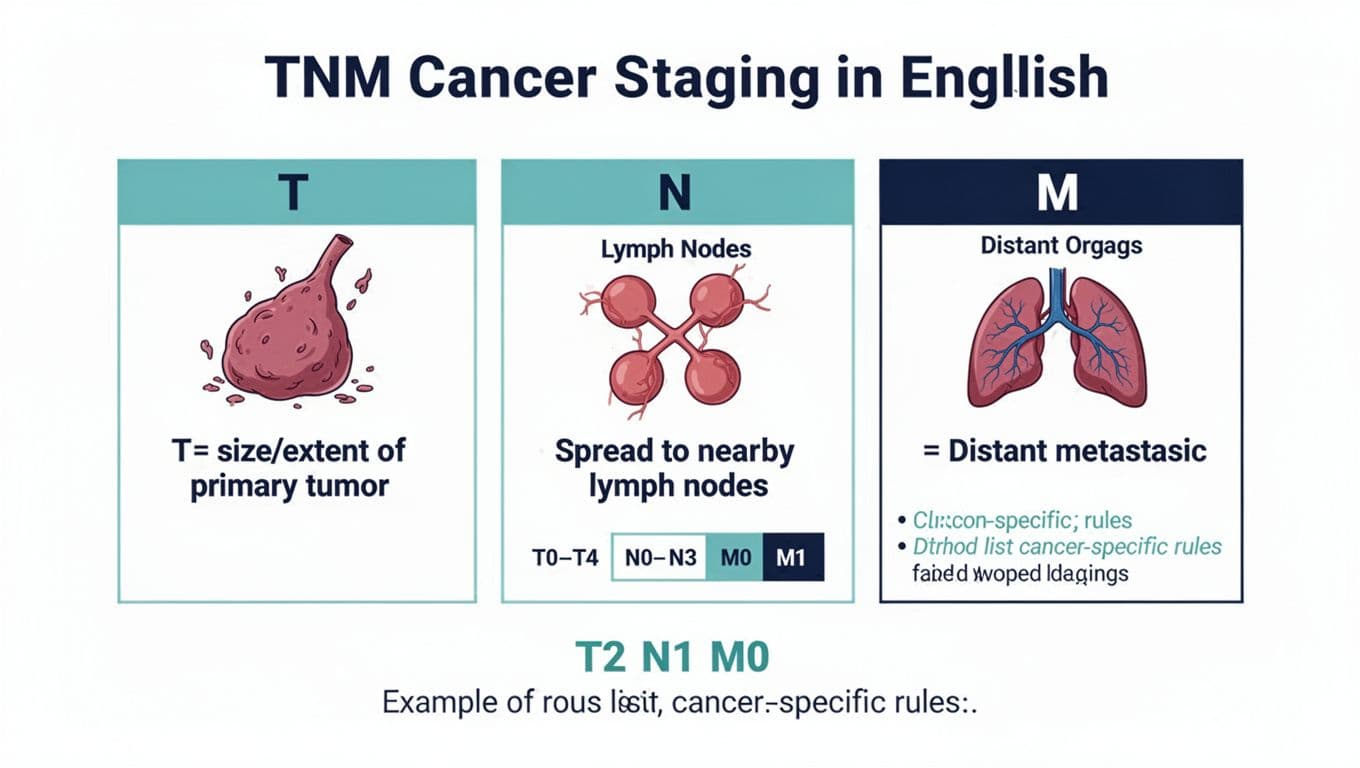
TNM is a shared language used by many cancer specialists when reviewing a pathology report. If you switch doctors, move cities, or get a second opinion, TNM helps everyone stay on the same page. For a simple definition from a trusted source, see the Canadian Cancer Society explanation of the TNM staging system. While this system is used for solid tumors, most blood cancers use a different method.
Here’s what the letters mean:
- T (Tumor): How big the primary tumor is, and how far it has grown into nearby tissue.
- N (Nodes): Whether cancer has reached nearby lymph nodes, and how many.
- M (Metastasis): Whether cancer has spread via distant metastasis.
Most cancers use ranges like T0 to T4, N0 to N3, and M0 or M1. Higher numbers often mean more spread, but the exact rules vary by cancer type. A T2 in one cancer doesn’t always equal a T2 in another.
This quick table can help you read a report without feeling lost:
| Letter | Plain-English question | Common range |
|---|---|---|
| T | “How big is it, and where has it grown?” | T0 to T4 |
| N | “Has it reached regional lymph nodes?” | N0 to N3 |
| M | “Has it spread to distant organs?” | M0 or M1 |
If you see X (like TX or NX), it often means the team doesn’t have enough information yet. That’s common early on.
A sample like T2 N1 M0 usually means: a medium-sized main tumor, spread to nearby nodes, and no distant spread found.
How TNM becomes Stage 0 to Stage IV (and why that matters)
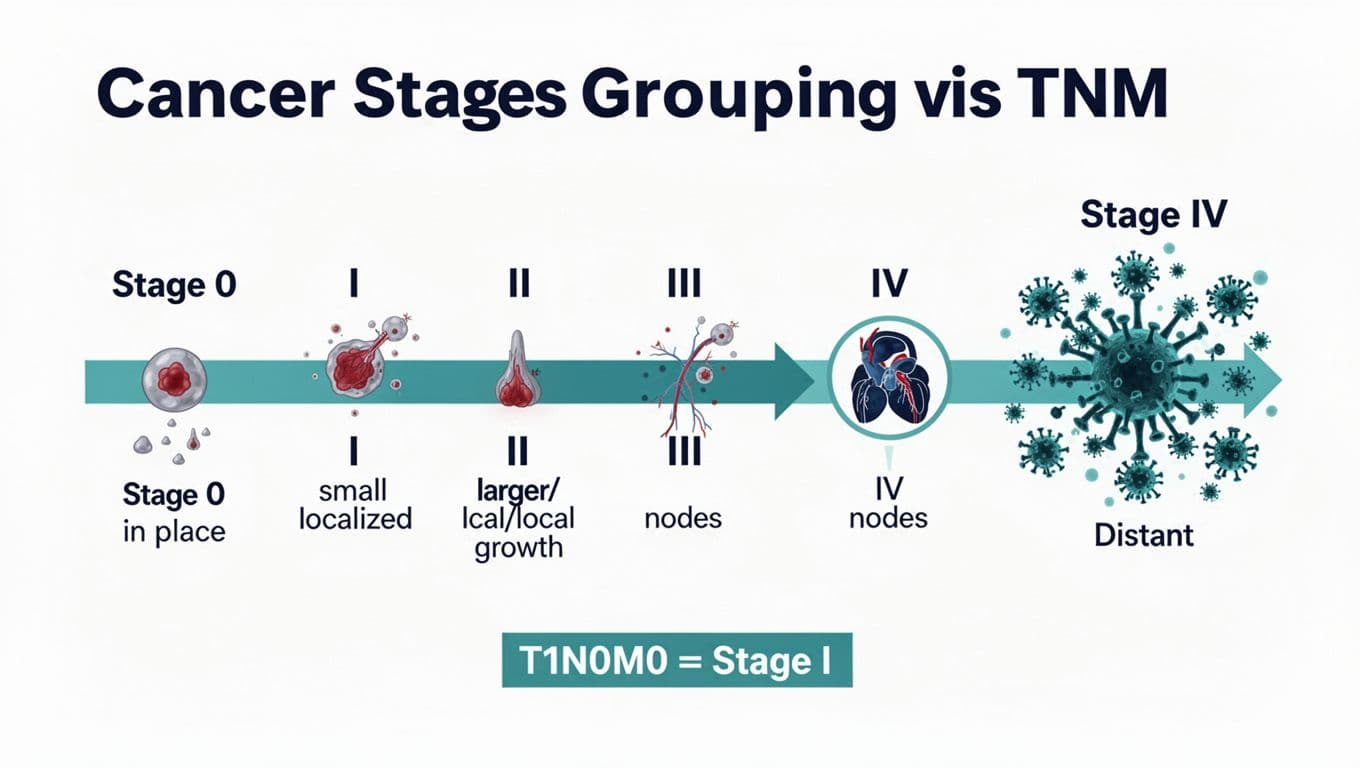
After TNM is assigned, many cancers also get a stage group in the number staging system, typically using Roman numerals for Stage 0 through Stage IV. If TNM is the detailed address, the stage group is the neighborhood name. It’s shorter, easier to say, and helpful for big-picture planning.
A common pattern looks like this:
- Stage 0: Carcinoma in situ, abnormal cells “in place,” not growing into deeper tissue.
- Stage I: Localized cancer.
- Stage II: Larger tumor or more local growth.
- Stage III: More local spread, often involving lymph nodes.
- Stage IV cancer: Distant spread (metastasis) is present.
However, staging isn’t one-size-fits-all. Breast cancer, colon cancer, lung cancer, and others each have their own staging rules. That’s why two people can both have “Stage II” and still have different treatment plans.
You may also hear two versions of TNM:
- Clinical stage (cTNM) is based on exams and imaging before major surgery.
- Pathological stage (pTNM) uses information from surgery and lab testing.
Takeaway: TNM is the detail, and the stage group is the summary your team uses to guide treatment plan decisions.
For more context on why staging matters and how it’s used in care, the National Cancer Institute overview of cancer staging explains it clearly.
What TNM can and can’t tell you (especially if you’re aiming for remission)
Staging brings clarity, but it also brings feelings. Sometimes it lands like a label you didn’t ask for. If you’re in treatment, newly diagnosed, or working toward remission, it helps to remember what TNM is built to do: guide care, not define you.
TNM often helps your team answer practical questions informed by diagnostic tests and imaging tests such as CT scans, MRI scans, and PET scans:
- Should surgery happen first, or should treatment shrink the tumor first?
- Do lymph nodes need extra attention with adjuvant treatment such as radiation or medicines?
- Is there evidence of distant spread, like metastatic cancer or secondary cancer, that changes the plan?
Still, TNM has limits. It doesn’t measure your grit, your support system, or how your body responds to treatment. It also can’t predict your personal story with certainty, including survival rates or fully personalized treatment. Two people with the same stage can have very different paths.
As of early 2026, the latest major update is the 9th edition TNM system (released in 2025). In some cancers, staging updates now pay more attention to lab features (like certain biomarkers and cancer grade) alongside what’s seen on scans and under the microscope. Cancer grade, which assesses features like well-differentiated cells, provides more detail than cancer staging alone. That doesn’t mean you need to memorize new science. It means your team may have more precise tools than even a few years ago. For a patient-friendly explanation of cancer stages, Cancer Research UK’s guide to the stages of cancer is also reassuring.
On the hard days, courage can look plain. It can look like showing up to an appointment, asking one more question, or reading your own report slowly.
If you need a reminder that fear and strength can exist together, these cancer survivor stories can feel like a hand on your shoulder. And if you’re trying to steady yourself during treatment, it may help to read about staying thankful during cancer treatment in small, realistic ways.
If staging information floods your mind at night, write down three questions for your next visit. Then let the rest wait until morning.
Conclusion: Let staging serve you, not scare you
The TNM staging system for cancer staging is a map, not a verdict. T, N, and M describe what doctors can measure today, so they can choose the next right step. Over time, that plan may change, and hope can grow right alongside it.
If remission is your goal, even with Stage IV cancer, keep asking for clarity, and keep tracking what helps you feel steady. Above all, protect your spirit while your body does its work. You’re more than a stage, and your story is still being written.