
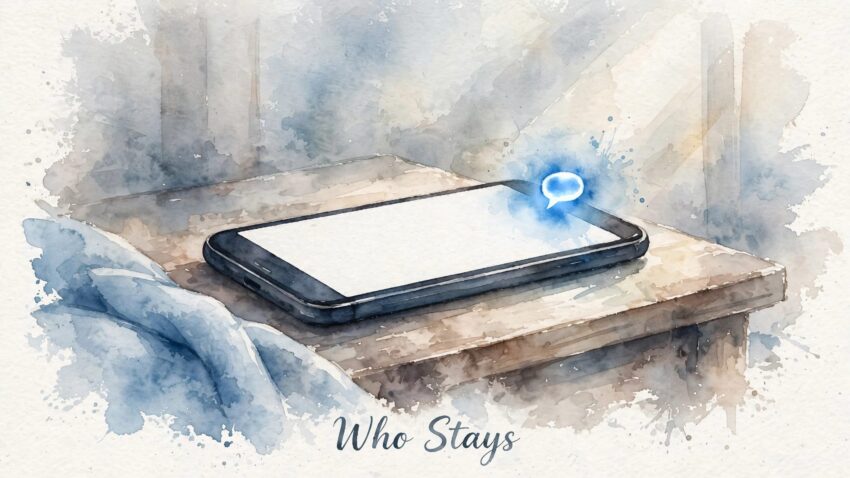
The phone used to buzz all day. A joke from an old colleague. A photo of someone’s dog. A text asking if I’d watched the game. Then came the diagnosis, and the phone went quiet.
It didn’t happen all at once. Illness works slower than that. First the messages grew shorter. Then they came less often. Then one Tuesday, I noticed the screen had stayed dark on the table beside me for three days. Silence has a sound. It sounds like a phone that doesn’t light up.
Why do people pull away? I’ve had plenty of time to think about it, and I don’t believe most of them are cruel. Fear drives many of them. They don’t know what to say, so they say nothing, because nothing feels safer than saying the wrong thing. Awkwardness drives others. A message that begins, “How are you, really?” demands an answer they dread. And underneath both sits something harder to admit. My illness reminds them that bodies break. That it could happen to them. Some people can’t stand next to that mirror.
I understand it. I don’t like it. Both are true.
The small silences taught me the most. The text that sat on “delivered” for nine days. The invitations that stopped coming because someone decided I wouldn’t feel up to it and never asked me. The acquaintance who met me at the pharmacy, studied his shoes, and said, “We should get together.” We didn’t. The card the whole office signed, with one expected name missing.
Then there’s the other kind of friend.
There’s the one who showed up on a gray afternoon with a pot of soup and asked no questions. Not how I felt. Not what the doctors said. Not whether I’d tried the supplement she’d read about online. She set the pot on the stove, washed the dishes in my sink, and sat with me while the television ran with the sound off. Before she left, she said, “I’ll be back Thursday.” She came back Thursday.
There’s the one who drove me to appointments and brought a crossword so my hands had something to do in the waiting room. There’s the one who sent a text every morning that said only, “No need to answer.” There’s the one who learned the names of my medications and never once stumbled over them. Small acts. Plain ones. They held me up.
Soup doesn’t cure anything. Yet it said what no speech could. You are still here, and so am I.
Do I forgive the ones who left? I wish I had a tidy answer. I don’t. Some days I do. I remember a time years ago when someone I knew fell ill, and I let a phone call slide for a week, then a month. I know how easy it is to look away. On those days, forgiveness comes without effort. Other days, anger sits at the table with me. Why did you leave when I needed you most? That anger is fair. I won’t scold myself for it.
Here’s where I’ve landed. I forgive them, but I don’t forget what the silence taught me. Forgiveness doesn’t require me to reopen every door. It requires only that I stop carrying the weight of their absence. A few of them have reached out since, sheepish and late. I answer them kindly. I simply know now whom I call first.
And I know what I owe.
When someone I know falls ill now, I don’t wait for the right words. I send the text. I send another the next week. I don’t ask, “Is there anything I can do?” because that hands the sick person a job. I drop off the soup. I write, “No need to answer.” I show up on Thursday.
I know what a quiet phone feels like. I also know what it costs to break that quiet. A few awkward minutes. That’s all. A few awkward minutes, set against a lifetime of someone remembering you came.
Show up. Then show up again.
