
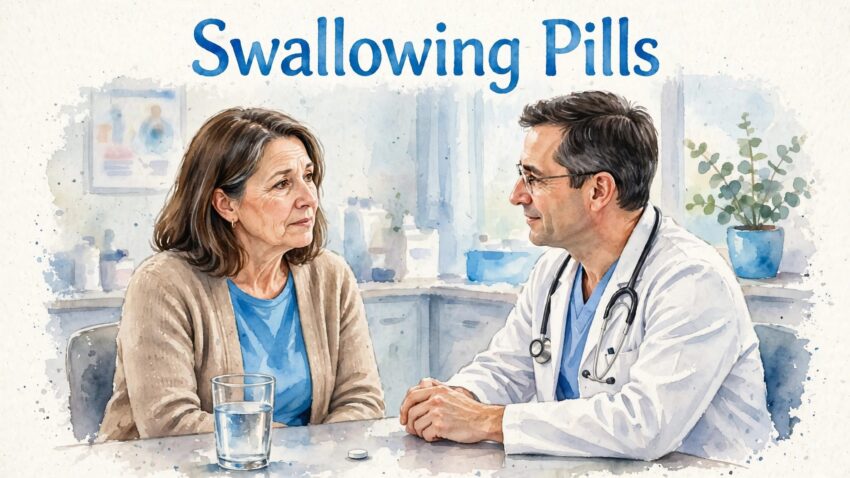
Difficulty swallowing pills during cancer treatment deserves a conversation with your oncology team before you change a dose or try another method. Your safety comes first, especially if food or water also causes trouble.
A task that once took seconds can carry fear when you already face a life-threatening disease. We can make room for that fear without asking you to push through it.
Start by describing what happens when you try to swallow.
Key Takeaways
- Call your cancer team about new swallowing problems, pain, coughing during meals, or difficulty drinking.
- Ask your pharmacist before crushing, cutting, opening, or mixing any medicine with food.
- Pill-swallowing techniques may help when you swallow food and liquids safely, but they don’t replace a swallowing assessment.
You deserve a plan that fits both your treatment and what your body can manage today.
What Is Making Swallowing Difficult?
Up to 40% of adults have trouble swallowing tablets or capsules. About one in three people may gag, choke, or vomit when trying to swallow a pill. These general estimates don’t tell us what causes your difficulty.
Fear can affect the body
Anxiety, fear of choking, and memories of gagging can make the next attempt feel harder. Your throat may feel tight before the pill reaches your tongue.
Anxiety can also cause a lump-like feeling when swallowing saliva. But new or persistent symptoms deserve assessment, especially during cancer treatment.
The NHS guidance on swallowing pills distinguishes pill-only difficulty from problems involving food and drink. That distinction helps your team choose the next step.
Treatment can change swallowing
Cancer treatment can cause dry mouth, mouth sores, nausea, or inflammation in the throat. Surgery and radiation near the head or neck can affect swallowing.
Other conditions, including Parkinson’s disease, can also interfere with swallowing. Doctors call a physical swallowing problem dysphagia.
Ask: “Could treatment, another condition, or one of my medicines explain this change?”
When Should I Stop and Call for Help?
Get emergency help for severe symptoms
Call emergency services if you cannot breathe, speak, or cough effectively during choking. Seek immediate medical help if you suddenly cannot swallow saliva or develop severe chest pain.
Don’t keep trying pills, food, or drinks when you cannot swallow safely. Don’t try to push a suspected blockage down with another mouthful.
Keep emergency contacts within reach. During a frightening moment, you shouldn’t have to search for a telephone number.
Contact your oncology team promptly
Call about painful swallowing, repeated coughing or choking, a wet-sounding voice after drinking, or food that feels stuck. Report worsening difficulty, weight loss, or trouble getting enough fluids.
Ask: “Do I need a swallowing assessment or help from a speech-language pathologist?”
These clinicians assess swallowing and recommend safer ways to eat, drink, and take medicine. Don’t assume thicker drinks or softer foods will solve the problem. Your swallowing needs may differ.
What Should I Do Before Trying Another Pill?
Only try home techniques if you swallow food and liquids comfortably and your care team considers them appropriate.
Sit upright. Take a few sips of water to moisten your mouth and throat, following any fluid restrictions. Take one pill at a time. If your schedule allows, starting with the smallest pill may help you settle into swallowing.
Some people find a straw helpful. Ask first if you have a swallowing disorder. Avoid throwing your head backward, which can make swallowing harder.
Stay upright for at least 10 to 15 minutes afterward. Some medicines require longer, so follow the instructions for your exact prescription.
If your mouth hurts or feels dry, ask about treating that discomfort before another attempt. Courage sometimes means pausing long enough to say, “Something has changed, and I need help.”
Two Techniques for Difficulty Swallowing Pills
Ask your team whether either method suits you. Don’t try these techniques if food or liquids cause coughing, choking, or difficulty.

The pop-bottle method for tablets
Place the tablet on your tongue. Close your lips firmly around the opening of a flexible water bottle.
Drink with a sucking motion, maintaining the seal as you swallow the water and tablet together. Don’t tilt your head far backward.
The bottle helps carry the tablet with the water. Stop if you cough, feel pain, or become distressed.
The lean-forward method for capsules
Place the capsule on your tongue. Take a sip of water, but hold it in your mouth.
Tilt your chin gently toward your chest, then swallow the capsule and water together. Capsules tend to float, so leaning forward can help position them for swallowing.
A study involving 151 adults found improved swallowing in 59.7% of tablet attempts with the pop-bottle method and 88.6% of capsule attempts with leaning forward.
Those figures describe improvement, not guaranteed success. The study doesn’t establish safety for people with cancer-related swallowing disorders.
Can I Crush It or Mix It With Food?
Ask about the exact medicine and formulation
Never crush, cut, or open an enteric-coated or extended-release medicine without your doctor’s or pharmacist’s approval.
Crushing extended-release medicine can release too much medicine at once. Damaging an enteric coating can expose the medicine to stomach acid or irritate the digestive tract.
A review of crushed medicine safety describes how altering tablets can change their effects.
Some cancer medicines also create harmful dust when someone crushes them. A score line doesn’t give permission to alter a cancer drug. Ask your oncology team about the exact name, strength, and formulation.
Food and juice can change the instructions
Don’t mix medicine into applesauce, pudding, or yogurt without your oncology team’s approval, especially when the instructions require an empty stomach.
Even medicines with similar names can have different food requirements. Ask your oncology team whether you may mix the medicine, how much food to use, and whether you must swallow it immediately.
Use water rather than grapefruit, orange, or apple juice unless your oncology team approves another drink. These juices can affect absorption or drug breakdown for some medicines, though they don’t interact with every medicine.
Our guidance on medication interactions during cancer treatment can help you bring foods, supplements, and medicines into the same conversation.
What If Neither Technique Works?
You don’t have to keep repeating an attempt that frightens or hurts you. Call your oncology team before the next dose becomes a missed-dose problem.
Ask these questions:
- “Does this medicine come as a liquid, dissolvable tablet, granules, or a smaller tablet?”
- “Could another medicine or route work for me?”
- “What should I do about today’s dose if I cannot swallow it?”
- “If I spit it out or vomit afterward, should I take another dose?”
Skin patches offer another route for some symptom medicines, but they don’t replace every oral drug. Liquids and dissolvable medicines also require a safety review when you have a swallowing disorder.
Don’t double a later dose or repeat a dose after vomiting without instructions. Don’t prepare medicine for a feeding tube unless your pharmacist provides a drug-specific plan.
Bring your current cancer medication list, including strengths, schedules, food instructions, supplements, and medicines for other conditions. Ask both care teams who will manage changes when another illness complicates treatment.
How Can We Help a Child Without Adding Pressure?
A child who struggles with pills needs patience and a safe plan. Pressure can strengthen fear, particularly when treatment already brings discomfort.

Practice according to readiness
Children generally begin practice around age 4 or later, depending on development and swallowing safety. Ask the pediatric oncology team first.
When the team agrees, begin with a tiny sprinkle or small candy and water. Move to larger practice pieces only after comfortable success. Never use actual medication for practice.
Aim for 5 to 10 minutes daily for about two weeks, stopping sooner if the child becomes upset. Avoid practice during mouth pain, nausea, or swallowing symptoms. Michigan Medicine offers child-focused pill-swallowing steps that emphasize gradual learning.
Ask for skilled support
A 2008 survey of 304 parents found that 70% of children aged 5 to 9 couldn’t swallow a standard tablet or capsule.
An American Academy of Pediatrics review examined 10 studies published between 2014 and 2022. Behavioral training and throat sprays helped some children, but study quality varied.
Ask the team before using sprays, pill coatings, or swallowing aids. Praise the child’s effort without turning each attempt into a test.
What Details Will Help My Team Understand?
You don’t need medical words to describe what happens. Tell your team when the difficulty began, which pills cause trouble, and whether food or water feels different.
Explain whether you feel pain, fear, gagging, coughing, or a sticking sensation. Mention mouth sores, dryness, recent weight changes, and anything you have already tried.
Ask: “Can we review every medicine and write down one safe plan for taking them?”
Request a full medication review when swallowing changes. Include prescriptions, over-the-counter products, vitamins, herbs, and occasional remedies. Ask whom to call after hours if you cannot take an essential dose.
A trusted person can help listen or write down instructions. There is room in this conversation for your fear as well as your symptoms. Both affect what the next morning feels like.
Frequently Asked Questions
When should I call my oncology team about difficulty swallowing pills?
Call promptly if swallowing is painful, you cough or choke repeatedly, your voice sounds wet after drinking, or food feels stuck. Seek emergency help if you can’t breathe, speak, or cough effectively, or if you suddenly can’t swallow saliva.
Can I crush, cut, or open a pill that is hard to swallow?
Ask your doctor or pharmacist about the exact medicine and formulation before changing it. Crushing or opening some medicines can change how they work, and some cancer medicines can create harmful dust.
Are pill-swallowing techniques safe for everyone?
The pop-bottle method may help with tablets, and leaning forward may help with capsules. Don’t try these methods if food or liquids cause coughing, choking, or difficulty, and ask your care team whether they’re appropriate for you.
What should I do if I can’t swallow a dose?
Call your oncology team before the dose becomes a missed-dose problem. Ask whether another form or route is available and what to do about that dose; don’t double a later dose or repeat one after vomiting without instructions.
A Safer Way Through the Next Dose
This difficulty deserves attention during treatment and in remission. The next step depends on what causes it and which medicine you need.
Our courage often appears in small moments, including the moment we ask for help. Tell your team what happens, avoid changing the medicine yourself, and let them help you find a safer way forward.
