
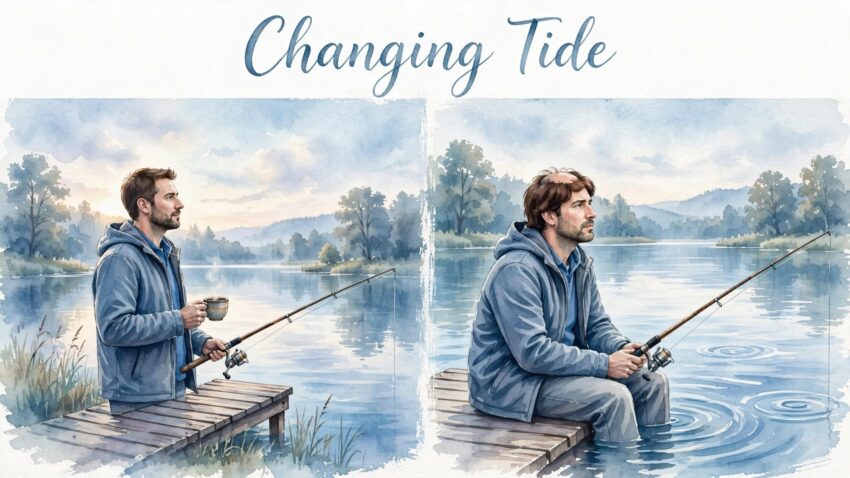
I found two photographs of myself. One from before. The second one from after. Both photographs were taken at the edge of a lake, and in both I held a fishing rod. In the first picture, I stood. In the second, I sat. In the first picture, I also held a cup of coffee in one hand.
In the first picture, my back was straighter. In the second, I wore a wig and was balding beneath it. Before this experience, I didn’t know anything about plasma cells. After this experience, I can tell you precisely what they are. Before this experience, I spent a lot of time thinking about baseball statistics, especially batting averages. Today, I spend most of my time thinking about my medical test results, especially my plasma cell count. In the second picture, I’m not broken. I’m just not who I was when I took the first picture.
For many months, I couldn’t figure out how to process that. Let me try naming some of the things I lost so I can stop pretending that losing them was insignificant.
First, I lost the body I could trust. A body that could help me carry a canoe, let me sleep through the night, and make me feel as though I didn’t even have a body.
Second, I lost the career that had defined how I introduced myself for thirty years. When someone asked me what I did, I had an answer. Now, I pause.
Third, I lost the ability to assume I had time. I could no longer say “someday” without knowing that a clock was ticking somewhere.
Fourth, I lost a type of friendship, not the friends themselves, but the versions of those friendships that never had to accommodate a disease diagnosis.
People will tell you that these aren’t true losses. They’ll tell you that you’ve gained some perspective. They’ll tell you that everything happens for a reason.
I don’t believe any of that, and I won’t suggest it to you. Losses are losses. Grieving your previous self isn’t self-pity. It’s honesty. Ignore it, and it’ll be waiting.
Next is the part that nobody takes pictures of. The middle ground. Your old self is gone, and your new self hasn’t arrived to take his place yet.
When people asked me how I was doing, I lied and said, “Fine.” Telling the truth would’ve taken much longer.
When my Tuesdays went from being filled with seeing patients to being empty days, I wasn’t sure whether I was still a doctor. I wasn’t sure whether I was still the stable force in my family. I didn’t know whether those titles had lapsed.
It’s difficult to explain how uncomfortable that was. It wasn’t exactly pain. It was more like standing in an empty house after the moving truck leaves. There are echoes and empty rooms. You know somebody is going to move into the house someday. You’re just not certain it’ll be you.
Fear doesn’t leave when grief arrives. They stay together. Fear sits at the table with grief, and neither one pours the coffee. Sometimes, I sat there with them for hours.
This is what I didn’t anticipate. Somewhere within that unresolved space between grief and fear, a new person began to emerge in small increments.
The first time I realized he existed was when I explained a lab report to a patient in the adjacent infusion chair and watched her shoulders drop slightly.
Another time, he emerged when he listened to a paragraph about fear and a woman wrote back to say that she had read it twice.
Finally, he emerged in the way I now listen more slowly, less concerned with providing answers and more interested in asking questions.
I also discovered that I could sit quietly without reaching for my phone to relieve my boredom. When I answered a question with “I don’t know,” I didn’t feel embarrassed or ashamed. I felt liberated.
Most importantly, when one of my best friend’s mothers received her own cancer diagnosis and my friend needed to talk to someone, he called me. He called me, not because he believed I had all the answers, but because he knew I wouldn’t cringe or flinch.
These aren’t victories based on the way I used to measure success. There was no promotion and no finish line. Even so, I felt something close to pride in a man I hadn’t consciously decided to become.
I no longer believe that grief and growth are opposites. Before this experience, I assumed I had to complete one before beginning the other. I thought I had to finish mourning the person who died at the lake before I could walk toward whoever or whatever came next.
That isn’t how it works. The grief didn’t cease entirely. It shifted location and made room. The growing continued during the same weeks, and sometimes during the same hours, as the grieving.
I still miss him, the man with the upright posture and the busy schedule. I always will.
This ache is good, though. It reminds me that my previous life existed and that it was truly worthwhile.
But I don’t live only in his absence. I exist alongside his loss. Mournful for what once was. Creating something new from what is here now.
Not one at a time. Simultaneously. Side by side. Still here.