
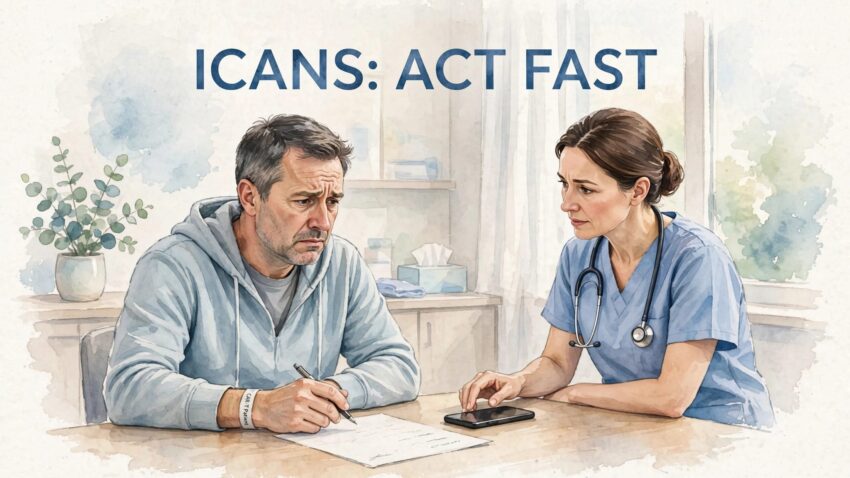
A missed word, shaky handwriting, or sudden confusion may be ICANS symptoms after CAR-T cell therapy, so contact the treating cell-therapy team immediately. Call 911 or local emergency services for severe or rapidly worsening neurologic changes, and don’t wait for symptoms to become dramatic or try to self-diagnose.
CAR-T treatment is a cellular immunotherapy that can offer real hope when cancer has returned or resisted other care. It can also bring risks that deserve clear eyes, a written plan, and someone nearby who knows what to watch for.
The goal isn’t to live in fear. It is to recognize a change early, before a small crack in the day becomes an emergency.
This article is educational and doesn’t replace your treatment center’s instructions, emergency services, or an in-person assessment.
Key Takeaways
- New word-finding trouble, messy handwriting, confusion, unusual sleepiness, tremors, poor balance, or seizures may be ICANS symptoms after CAR-T cell therapy.
- Contact the treating cell-therapy team immediately for any suspected symptom, even if it is mild, intermittent, or temporarily improves.
- Call 911 or local emergency services for seizures, inability to awaken, trouble breathing, fainting, new one-sided weakness, facial droop, or severe or rapidly worsening confusion.
- ICANS can overlap with cytokine release syndrome, infection, stroke, medication effects, and other emergencies, so the cause must be assessed by clinicians.
- Do not self-diagnose, change medicines, coach or repeat ICE testing at home, or wait for symptoms to become dramatic before seeking help.
What ICANS Means After CAR T-Cell Therapy
ICANS stands for immune effector cell-associated neurotoxicity syndrome. The name is long. The meaning is simpler: it is an inflammatory complication that can affect brain function after cancer immunotherapy activates the immune system.
CAR-T cells are a person’s own T cells, engineered in a lab with a chimeric antigen receptor to recognize a target on cancer cells. After CAR-T cell therapy, those cells multiply and go to work. Sometimes, the immune response becomes too intense. Inflammatory chemicals can then affect the central nervous system, causing neurotoxicity.
Why the brain can get caught in the immune response
The brain has a protective filter called the blood-brain barrier. During a strong inflammatory reaction, that filter may become less secure. Changes in this barrier may allow immune signals or fluid to influence brain function, but the mechanisms aren’t fully understood.
ICANS is an acute treatment-related complication, not a diagnosis of permanent neurologic disease. It can progress quickly, which is why hospitals monitor patients closely after infusion. The treating team evaluates the symptoms and determines the diagnosis and severity.
The ASTCT grading guidance for immune treatment toxicities gives care teams shared language. The treating team uses current ASTCT or other authoritative guidance to make the diagnosis and assess severity.
ICANS Symptoms That Need a Call Now
Any suspected ICANS after CAR-T cell therapy requires immediate contact with the treating cell-therapy team. Call even if symptoms are mild, intermittent, or improve temporarily.
A person with ICANS may not realize something is wrong. A caregiver may notice it first. You may hear an answer that doesn’t fit the question. You may see a loved one stare at a familiar object and struggle to name it.
Don’t talk yourself out of calling because a symptom comes and goes. The first signs can look ordinary, but this isn’t a moment to wait until morning. A normal temperature or calm appearance doesn’t make the situation safe.
Early brain changes can be easy to miss
Watch for changes that are new, sudden, or clearly worse than the person’s usual treatment fatigue:
- New word-finding trouble, inability to name familiar objects, or aphasia, meaning difficulty producing or understanding language.
- Handwriting that suddenly becomes messy or small, or new difficulty writing a sentence.
- New confusion, disorientation, slowed thinking, or difficulty following commands that may reflect cognitive impairment.
- Reduced alertness, unusual sleepiness, agitation, or behavior that feels out of character.
- Tremor, shakiness, poor balance, or new imbalance.
- A new headache or another sudden change in thinking or behavior.
- New seizure activity, which needs emergency help.
These changes may represent treatment-related neurotoxicity, but the cause can’t be diagnosed at home. Infection, low oxygen, medication effects, stroke, seizure, CRS, and ICANS can overlap. Report what you observe rather than trying to determine the cause.
Brain fog can happen during cancer treatment. So can exhaustion. Yet after treatment, new mental changes deserve an urgent report. A caregiver’s instincts matter here.
Emergency signs cannot wait
Call the treating team immediately for any ICANS symptoms, even if they seem mild, intermittent, or temporarily better.
Call 911 or seek emergency-department evaluation for seizures, inability to awaken, fainting, or trouble breathing. Do the same for new one-sided weakness or facial droop, sudden loss of speech, severe or rapidly worsening confusion, or any concern for stroke.
Don’t drive the person yourself during a serious neurologic change unless emergency professionals direct you to do so. Follow dispatcher or clinical-team directions. Bring the CAR T discharge paperwork and the treatment center’s phone number if you go to an emergency department.
A person can look calm while their ability to speak, write, or stay awake changes. Those changes are enough to seek urgent help.
When ICANS Symptoms Usually Appear
ICANS most often begins in the days after CAR-T cell therapy, but timing isn’t predictable. Many people develop it around the same time as, or shortly after, cytokine release syndrome (CRS). CRS is an inflammatory reaction after infusion. It can cause fever, low blood pressure, fast heartbeat, and low oxygen levels.
A fever after CAR T always needs attention because it may signal CRS, infection, or both. The care team must sort that out and may use tocilizumab for CRS when indicated.
CRS can come first, but not always
Some people develop neurologic symptoms after cytokine release syndrome (CRS), an inflammatory reaction after infusion, begins to settle. Others have ICANS without severe CRS, and CRS may precede, accompany, or occur independently of neurologic changes. Improvement after tocilizumab doesn’t rule out ICANS or replace neurologic monitoring. The order varies, so a normal temperature doesn’t exclude a neurologic emergency.
Risk factors include higher tumor burden before infusion and a stronger inflammatory response afterward. The product’s chimeric antigen receptor design also matters. Tumor burden is only one factor, alongside product characteristics, disease type, and patient-specific features. Your team knows the risk pattern linked to the treatment you received.
For a plain-language picture of the process, read what to expect after CAR T-cell infusion. Knowing the watch period before you come home can make the first days feel less like walking through a dark room.
How the ICE score checks thinking
At the bedside, clinicians often use the Immune Effector Cell Encephalopathy, or ICE, assessment. It is a quick 10-point check of thinking and language. It doesn’t measure intelligence. It shows whether brain function has changed from one assessment to the next and can help monitor immune effector cell-associated neurotoxicity syndrome.
What happens during an ICE assessment
During repeated bedside assessments, the ICE score may involve asking the person to state the year, month, city, hospital, or clinic. They may also name three objects, follow a simple command, write a sentence, and count backward from 100 by tens.
These checks are clinician-administered, not a home test. Caregivers shouldn’t coach answers, repeatedly test the person, or delay emergency help to calculate a result.
A result of 10 is normal. A lower result tells the team to look more closely and repeat the assessment. Trouble with writing or word-finding can show up before a person seems severely confused in everyday conversation.
What the grades tell the medical team
The score is only one part of the picture. The ASTCT grading scale also considers level of consciousness, seizure activity, focal motor weakness, and signs of increased pressure or swelling in the brain. The score captures cognitive and language changes, but it doesn’t capture every neurologic danger of neurotoxicity.
| ICANS grade | ICE result and common picture |
|---|---|
| Grade 1 | Result of 7 to 9, with no depressed level of consciousness, seizure, motor weakness, or signs of increased pressure |
| Grade 2 | Result of 3 to 6, or awakens to voice with depressed consciousness, without seizure, motor weakness, or signs of increased pressure |
| Grade 3 | Result of 0 to 2; awakens only to touch; a clinical or electrographic seizure resolving in under 5 minutes; focal motor weakness such as hemiparesis; or focal or local swelling on brain imaging |
| Grade 4 | Result of 0; cannot be aroused or needs vigorous, repeated touch; stupor or coma; a seizure lasting over 5 minutes or repeated clinical or electrographic seizure activity without return to baseline; deep focal motor weakness; or increased pressure signs, including diffuse cerebral oedema (brain swelling), abnormal posturing, or cranial nerve VI palsy |
The clinical overview of ICANS management explains why the worst qualifying feature determines the grade. This table supports clinician communication, not caregiver self-grading, and numbers never replace watching the person in front of them. A seemingly normal result doesn’t make seizures, a focal deficit, inability to awaken, breathing problem, or another emergency sign safe.
Emergency Steps for Patients and Caregivers
Fear can make anyone freeze. Suspected ICANS after CAR-T cell therapy is an emergency. Contact the treating cell-therapy team immediately. Call 911 or emergency services for severe neurologic symptoms, breathing problems, collapse, or prolonged or repeated seizures. Don’t wait until morning.
Keep the treatment center’s 24-hour number in your phone and on paper. Keep your discharge documents nearby. Know where the nearest emergency department is. Ask the team before discharge how far from the hospital you may stay and who should remain with you during the highest-risk days.
A practical plan when something changes
When you call, say that the person recently received CAR T-cell therapy. Describe the exact change and when it began. “She couldn’t write her name at 3 p.m.” helps more than “She seems off.”
Have these details ready:
- The CAR T infusion date and the name of the treatment center.
- Any fever, chills, dizziness, falls, headache, or breathing changes.
- All current medicines, including seizure prevention medicine.
- The person’s usual memory, speech, and mobility before the change.
- Whether symptoms have worsened, improved, or returned after seeming better.
Don’t drive someone with a serious neurologic change unless emergency professionals direct you to do so. Don’t give leftover medicines, alcohol, sleep aids, or someone else’s prescription. Don’t change steroids or anti-seizure medicines without guidance from the clinical team.
If a seizure occurs, don’t restrain the person or put anything in their mouth. Clear nearby hazards and protect the person’s head if possible. Note when the seizure starts, then follow the emergency dispatcher’s instructions. If the person is drowsy or has impaired consciousness, don’t give food, drink, or oral medicines unless the dispatcher or treating team says it’s safe.
Stay with the person. Keep the room calm and reduce fall risks. Provide only the supportive care directed by clinicians while waiting for help. These steps don’t diagnose or treat ICANS at home.
How the Hospital Treats Severe Neurotoxicity
After CAR-T cell therapy, the care team checks for infection, low oxygen, bleeding, metabolic problems, medication effects, or stroke. They may order blood tests, a brain scan, electroencephalography (EEG) for nonconvulsive seizure activity, or a spinal fluid test when needed.
These tests do not prove ICANS on their own. ICANS is a clinical diagnosis based on timing, severity, symptoms, and repeated neurologic examinations. The team also considers concurrent cytokine release syndrome and rules out other emergencies.
Steroids and seizure care
For mild grade 1 symptoms, teams may use supportive care, including close monitoring, oxygen or airway support, and fall prevention. Intensive-care measures may be added when clinically indicated. Grade 2 or more serious ICANS often calls for corticosteroids, commonly dexamethasone.
Severe cases may require high-dose methylprednisolone and intensive care, while dexamethasone may be used under specialist direction. Clinicians adjust and taper steroid treatment based on observed improvement, so families shouldn’t change these medicines at home. Brain swelling, also called cerebral oedema, is a life-threatening complication requiring hospital management.
Clinicians may monitor for seizures, use levetiracetam or another anti-seizure medicine, and consider anakinra for selected severe or refractory cases. Product-specific protocols can differ by patient, so current ASTCT, ASCO, EBMT, product-label, and institutional guidance should direct these choices for chimeric antigen receptor products. The University of Illinois review of CAR T drug treatment distinguishes tocilizumab, which clinicians use primarily for cytokine release syndrome when indicated, from isolated ICANS. Tocilizumab isn’t a treatment for isolated ICANS, and it shouldn’t be self-administered or used to delay neurologic evaluation.
After the Crisis: Recovery Takes Patience
Many people improve as inflammation settles and treatment works. Recovery from treatment-related neurotoxicity may take days to weeks. Some people need rehabilitation, speech-language therapy, or cognitive follow-up.
Confusion can leave a person embarrassed, frightened, or unable to remember what happened. Caregivers may feel shaken too. Both responses make sense. A life-threatening disease already asks too much from a family. An unexpected brain complication can make the ground feel unsteady again.
Returning to daily life without shame
After discharge, report persistent or returning word-finding difficulty, tremors, headaches, poor sleep, mood changes, or memory and attention problems to the treating team. These may reflect cognitive impairment and shouldn’t wait for a routine appointment. Seek emergency help for sudden or severe neurologic changes. Keep follow-up appointments, written notes, and phone reminders when thinking feels unreliable.
Recovery doesn’t erase the emotional weight of treatment. For an honest look at that journey, Cancer Fighter’s Journal speaks to the fatigue, grief, and courage that can exist during treatment. Emotional support can help, but it doesn’t replace medical follow-up.
Frequently Asked Questions
What are the early symptoms of ICANS after CAR-T cell therapy?
Early symptoms can include trouble finding words, difficulty naming familiar objects, messy handwriting, confusion, slowed thinking, unusual sleepiness, agitation, tremors, or poor balance. A new headache or change in behavior may also need urgent attention.
When should I call the treating team?
Call the treating cell-therapy team immediately for any new or worsening neurologic change, even if it comes and goes or improves temporarily. Do not wait until morning or try to determine at home whether the cause is ICANS.
When should I call 911?
Call 911 or local emergency services for a seizure, inability to awaken, fainting, trouble breathing, severe or rapidly worsening confusion, new one-sided weakness, facial droop, or sudden loss of speech. Follow dispatcher instructions and do not drive the person yourself during a serious neurologic change unless emergency professionals direct you to do so.
Can ICANS happen without cytokine release syndrome?
Yes. ICANS often occurs around the same time as or after cytokine release syndrome, but it can also occur without severe CRS. A normal temperature or improvement after CRS treatment does not rule out ICANS.
How do clinicians diagnose and grade ICANS?
Clinicians use repeated neurologic examinations and may perform an ICE assessment, which checks orientation, language, writing, following commands, and attention. They also consider consciousness, seizures, weakness, and signs of brain swelling while checking for other causes such as infection, stroke, low oxygen, or medication effects.
A Clear Response Can Protect What Matters
A small, new neurologic change after CAR-T treatment deserves an immediate call to the treating cell-therapy team. Don’t self-diagnose, change medicines, or wait for the problem to become obvious.
Severe confusion, trouble speaking, seizures, or loss of consciousness require 911 or emergency-department evaluation. This information doesn’t replace medical advice, so follow your care team’s instructions. Keep the phone number, discharge plan, and caregiver observations ready so clinicians can respond quickly.