
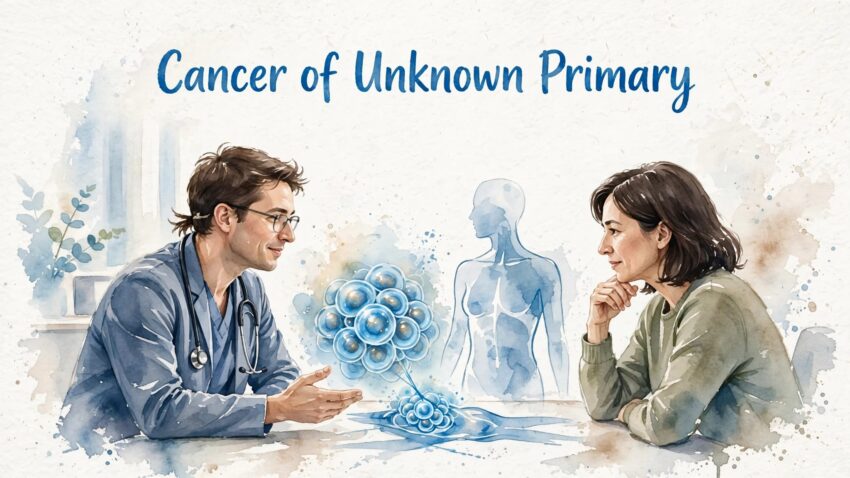
Cancer of unknown primary (CUP) means doctors have found cancer that has spread, but tests haven’t identified where it began. Your team can still use the cancer cells, scan findings, and your health needs to guide treatment.
Hearing “unknown” alongside a life-threatening disease can leave you feeling that the ground beneath you has shifted. You deserve clear explanations, room for your questions, and care that addresses both the cancer and the uncertainty.
Understanding what your team already knows can help you approach the next conversation with greater confidence.
Key takeaways
- CUP describes cancer with no identified starting point after appropriate investigation.
- Biopsy findings, scans, and sometimes molecular tests help doctors choose treatment even when the original tumour remains hidden.
- Survival figures describe groups of people, not your personal future. Your cancer’s characteristics, treatment response, and overall health matter.
What cancer of unknown primary tells your team
The starting point remains unclear
The primary site is where cancer first developed. Metastatic cancer means cancer cells have spread to another part of the body, a process called metastasis.
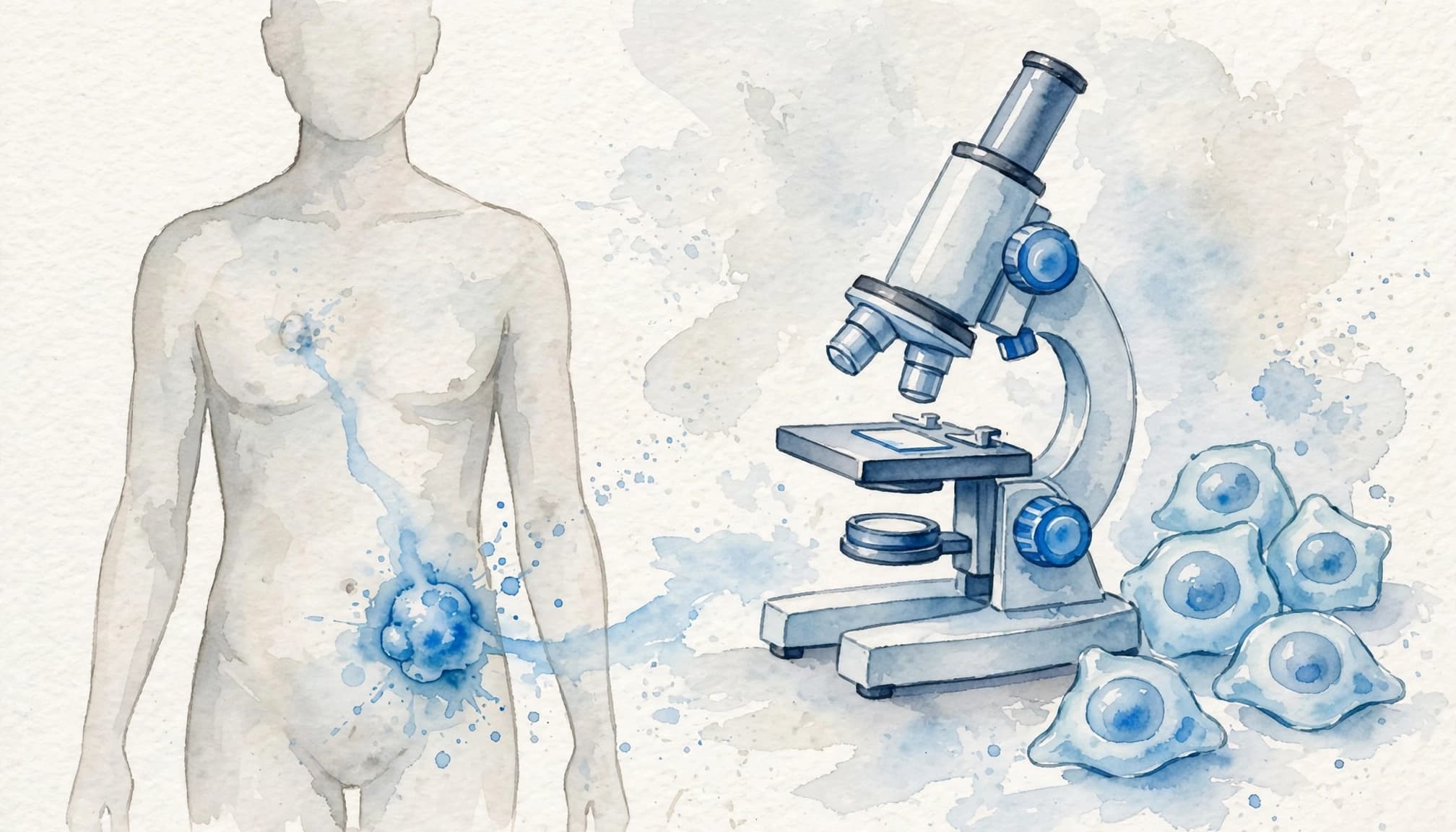
An occult primary means doctors can’t find where the cancer began despite appropriate tests. With CUP, doctors find cancer in another location but cannot identify the primary site. A tissue sample can reveal the cell type and clues about treatments that might help.
An ASCO review estimates that CUP accounts for about 2% to 3% of metastatic cancer diagnoses annually in the United States. Better imaging has helped reduce its frequency.
Why the primary tumour can stay hidden
A small original tumour can escape detection even when cancer elsewhere grows large enough to find. Sometimes the immune system may destroy the original tumour after cells have already spread.
An ASCO review describes 884 autopsies in which investigators found an invasive primary tumour in 73% of cases. Many measured 1 centimetre or less. Investigators identified more than 20 different primary sites.
These findings help explain why even careful testing cannot always locate the beginning.
How doctors investigate the diagnosis
Your team brings together your medical history, examination, laboratory results, and images. Each finding helps them decide which investigation could change your care.
A biopsy gives the first important clues
A biopsy removes a small tissue sample through a needle or another procedure. A pathologist, a doctor who studies tissue, examines the cells under a microscope.
The laboratory examines biopsy tissue and may use immunohistochemistry, a test that uses antibodies to attach to particular cell markers. Immunohistochemistry staining patterns help the pathologist identify features of the cancer.
The American Cancer Society’s testing guide explains these investigations. Your team may recommend another biopsy when the first sample lacks enough cells or leaves an important question unanswered.
Scans and other procedures narrow the search
A CT scan creates detailed pictures inside your body. Based on the findings, doctors may use a CT scan to image the head and neck, chest, abdomen, and pelvis. Doctors reserve a PET scan for selected situations rather than routinely using it to search for every hidden primary.
TNM staging describes the primary tumour, nearby lymph nodes, and metastasis when that framework applies. Your team can explain how a staging label applies when the primary remains unknown.
An endoscopy uses a thin viewing instrument to examine an internal area. Examples include bronchoscopy for the airways and colonoscopy for the bowel.
When fluid collects in the abdomen, paracentesis removes some for testing or relief. Thoracentesis removes fluid around a lung. Laboratory analysis may provide further clues.
What tumour-marker blood tests can show
Tumour markers are substances that some cancers release or cause the body to produce. They can suggest a direction for further investigation, but they cannot establish the primary site alone.
Doctors select markers according to the other findings.
| Marker | What an elevated result may suggest |
|---|---|
| AFP and HCG | Germ cell tumours, which develop from reproductive cells |
| CA125 | Ovarian cancer, among other conditions |
| PSA | Prostate cancer |
| CA19-9 | Pancreatic, liver, gallbladder, or bile-duct cancers |
| CEA | Several cancer types; it doesn’t reliably identify one origin |
Some non-cancerous conditions also raise these markers. Your team interprets the results alongside tissue findings and scans.
Ordinary blood tests matter too. Kidney function, liver function, and blood-cell counts help doctors understand your health and plan treatment safely.
How molecular testing may guide care
Molecular profiling tests examine patterns or changes inside cancer cells. Two tests can answer different questions, so it helps to understand what your team hopes to learn.
Gene expression profiling looks for an origin
Gene expression profiling (GEP) compares the cancer’s pattern of gene activity with patterns from known cancers. It estimates which tissue the cells most resemble.
The ASCO review reports accuracy of about 90% to 95% in known cancers and estimates of 80% to 90% in CUP. These figures describe test performance, not a promise that testing will identify your cancer’s origin correctly.
Some tests need only 300 to 500 living cancer cells. Careful handling of needle-biopsy tissue helps preserve enough material for possible later testing.
Genomic profiling looks for treatment targets
Comprehensive genomic profiling searches for changes in cancer-cell DNA that might offer a treatment target. ASCO reports potentially targetable findings in about 30% of patients. A potential target doesn’t always mean an available or suitable drug.
Targeted therapies block particular proteins or growth signals. They can help selected patients, but they also cause side effects, and cancers can develop resistance.
The CUPISCO trial results found longer progression-free survival with molecularly guided treatment than continued chemotherapy in selected patients. This means more time before cancer worsened, not proof of cure or a benefit for everyone.
What treatment can involve
Your team considers the tissue findings, extent of cancer, treatment targets, and your ability to tolerate treatment. Your priorities belong in that conversation too.

Matching treatment to the available evidence
When findings strongly suggest a particular origin, doctors may offer site-specific therapy, treatment designed for that cancer type. Cancer in neck lymph nodes may suggest head and neck squamous cell cancer. Cancer in armpit lymph nodes may suggest a breast primary.
If doctors can’t identify a likely origin, they may recommend empiric chemotherapy to treat several possible cancer types based on the available evidence. Carboplatin and paclitaxel form one commonly used combination.
Doctors may select molecular-guided therapies to target a cancer-cell change found through testing. A potential target doesn’t guarantee that a suitable drug exists or will help. Suitable molecular findings may support immunotherapy, which helps the immune system attack cancer.
Surgery, radiotherapy, or hormone treatment may help in selected circumstances. The National Cancer Institute’s treatment overview describes these options.
Our guidance on preparing for treatment decisions can help you put your own priorities into words.
When comfort needs greater attention
What matters most to you today? Time at home, relief from discomfort, and enough energy for a conversation may carry great weight.
If you feel very unwell, more tests or intensive treatment may create burdens without enough likely benefit. Your team should explain that balance honestly.
Palliative care treats symptoms and supports emotional and practical needs. You can receive it alongside cancer treatment. Choosing comfort-focused care still means receiving active, attentive care.
How to understand CUP survival figures
What the one-year and five-year figures mean
Cancer Research UK’s survival information gives these broad estimates: around 20 out of 100 people survive one year or more, and around 10 out of 100 survive five years or more. The 5 year survival figure is the proportion of people who live at least five years after diagnosis.
There are no UK-wide CUP survival statistics. Cancer Research UK draws on figures for Northern Ireland diagnoses during 2013 to 2017 and Wales diagnoses during 2017 to 2021.
These numbers can hurt to read. They combine people with different cancers, health conditions, and treatment opportunities. A survival rate describes outcomes in a group, not how much time you have.
Why your own outlook may differ
ASCO describes about 20% of patients as having “favorable CUP” and about 80% as having “unfavorable CUP.” These medical categories describe disease patterns and treatment prospects, never a person’s worth or effort.
For unfavorable CUP, the review reports median survival of roughly six to nine months with conventional treatment. A median means half the group lived longer and half lived less time. It measures something different from one-year or five-year survival.
Cancer in a limited area, a treatable cell type, general fitness, and treatment response can affect outlook.
A group survival figure cannot account for all the findings your team learns about your particular cancer.
Questions to bring to your appointment
Fear can make a familiar question disappear when the appointment begins. Writing a few questions down gives you something steady to return to.
- What does the biopsy tell us, and what remains uncertain?
- Which further test could change my treatment, and do we have enough tissue?
- What benefit do you expect from treatment, and what burdens might it bring?
- Who should I contact when symptoms worsen or I need emotional support?
Our questions for your oncologist offer additional prompts. Bring someone who can listen or take notes if that would help.
Frequently asked questions
Can cancer of unknown primary go into remission?
Yes, treatment can produce remission in some people. Remission means cancer signs decrease or disappear. It doesn’t always mean cure. Some limited or particularly treatment-sensitive forms of CUP offer a possibility of cure, while widespread disease usually requires treatment focused on control and comfort.
Does an unknown primary mean testing should continue indefinitely?
No. Further testing makes sense when the result could meaningfully change treatment or care. Your team weighs that benefit against discomfort, risk, and delay. Doctors can sometimes recommend a sound treatment plan without ever locating the primary tumour.
You deserve clarity and compassionate care
An unknown starting point leaves difficult questions, but your team can still build a plan around what the cancer reveals. You deserve honest explanations and support for the choices ahead.
Courage may mean asking one more question. It may mean accepting help while someone sits beside you. You don’t have to carry every uncertainty alone.
